
All Posts
Agentic AI Explained: What It Does, How It Works, and Why It Matters Now
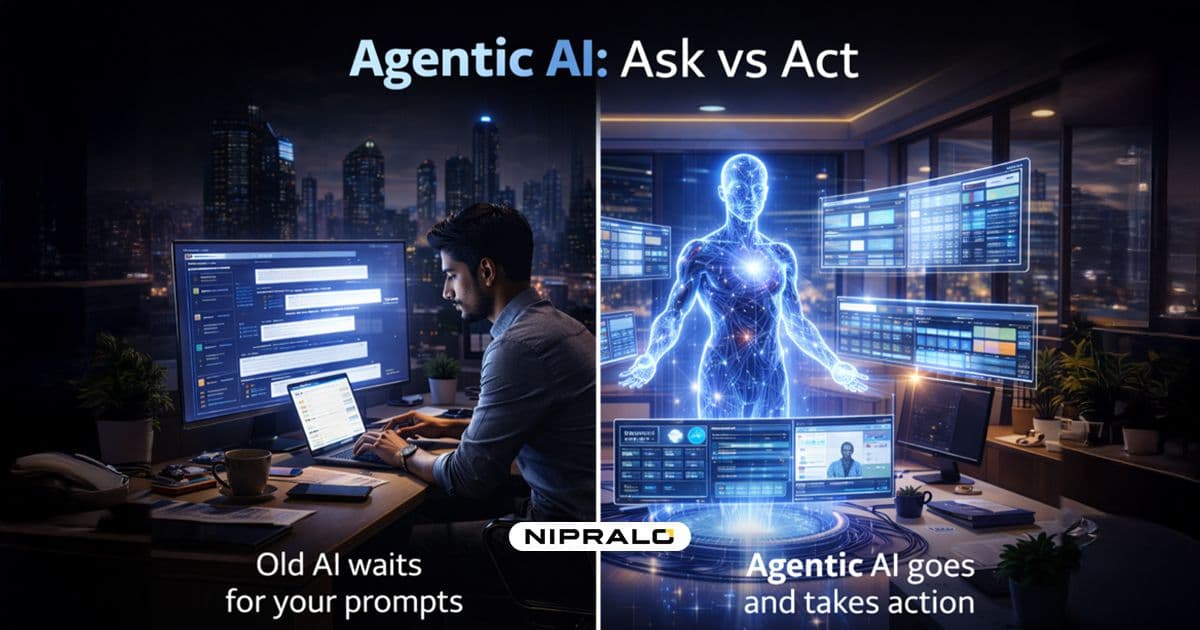
Old AI waits for you to ask it something. Agentic AI goes and does things on its own. It books the meeting, writes the follow-up email, checks the calendar, spots the conflict, and tells you when it is done. No hand-holding. No step-by-step instructions from you.
That is the shift. And right now, in 2026, it is the biggest conversation in enterprise technology.
If you heard the term at a board meeting, saw it in a news headline after NVIDIA's GTC conference, or had a vendor pitch it to you last week - this post gives you the full picture. What it actually is. How it works. What businesses are doing with it today. And what you should be thinking about if you run a company.
We will keep this plain. No research-paper language. No buzzwords.
The One-Sentence Answer
Agentic AI is an AI system that can take a goal, break it into steps, and complete those steps on its own - using tools, making decisions, and adapting along the way - without needing a human to direct every move.
That is it. Everything else is just detail.
The word "agentic" comes from the idea of an agent: something that acts on your behalf. Not something that answers your questions. Something that does your work.
Agentic AI vs Generative AI: What Is Actually Different
Most people have used generative AI. You type something in, it gives you something back. A piece of text, a summary, a piece of code. You prompt it. It responds. Done.
Agentic AI is different in three important ways.
It can use tools. A generative AI model produces output. An agentic AI can open your CRM, send an email, run a search, read a spreadsheet, and update a database. It connects to real systems and takes real actions.
It works across multiple steps. Generative AI handles one exchange at a time. Agentic AI can manage a ten-step workflow, remember what it did in step two when it gets to step eight, and change course if something unexpected happens in between.
It acts without being prompted at each step. You give it a goal. It figures out the path. You do not manage it task by task.
Think of it this way. Generative AI is a very smart assistant who answers every question you ask. Agentic AI is a very capable colleague who you can hand a project to and trust to get it done.
How Agentic AI Works: Perceive, Reason, Plan, Act, Learn
Under the hood, agentic AI systems run on a loop. Every good explanation of this loop uses roughly the same five stages.
Perceive
The agent takes in information. This could be a goal you give it, data from a connected system, an email that just arrived, or a change in a database it is watching. It reads the situation.
Reason
It thinks about what the information means. What is the task? What do I already know? What do I still need to find out? This is where the intelligence lives: the ability to interpret context, not just follow a script.
Plan
The agent maps out the steps needed to reach the goal. It decides what to do first, what tools to use, what order makes sense, and what to do if something goes wrong.
Act
It executes. Sends the email. Updates the record. Books the slot. Runs the search. Writes the draft. Calls the API. It takes real actions inside real systems.
Learn
Good agentic systems review the output. Did the action achieve the goal? What can be adjusted next time? This feedback loop is what lets agents improve over time.
This perceive-reason-plan-act-learn cycle is what separates agentic AI from a simple automation script. A script follows a fixed path. An agent reads the situation and decides the path.
10 Real-World Agentic AI Examples from 2026
This is where it gets concrete. Here are examples across industries that are running right now, not in theory.
Sales: AI SDRs That Book Meetings Without a Rep
Agentic sales development reps monitor signals like website visits, job changes, and intent data. They personalise outreach across email and chat, follow up across multiple touchpoints, and book meetings directly into a sales rep's calendar. No rep involvement until the meeting is confirmed.
HR: Scheduling That Fixes Itself
When a staff member calls in sick, an HR agent detects the gap, checks availability across the team, sends cover requests, updates the schedule, and notifies the relevant manager. What used to take two phone calls and a spreadsheet update takes seconds.
Supply Chain: Rerouting Without Human Input
A shipment is delayed. Weather has disrupted a route. An agentic supply chain system detects the disruption, identifies alternative suppliers or routes, notifies vendors, updates delivery timelines, and adjusts inventory projections - before any human even opens their laptop. Microsoft's supply chain agent deployments are a live example of this at scale.
Legal: Contract Review Without a First Pass
Legal agents scan incoming contracts, flag non-standard clauses, compare terms against a company's approved template, and produce a summary for the lawyer to review. The lawyer spends time on judgment calls, not on reading every line of a 40-page NDA.
Healthcare: Cutting Admin Time for Clinicians
AtlantiCare's clinical AI agent handled documentation for 50 providers and delivered a 42% reduction in documentation time, saving roughly 66 minutes per provider per day. The agent handled ambient note generation so the clinician could focus on the patient.
Customer Service: Issues Resolved Before a Ticket Is Raised
A retailer's agentic system handles phone calls, routes queries, and sends outbound follow-ups. One Forbes-cited deployment saw a 9.7% increase in new sales calls, a 47% drop in store calls, and an improvement of $77 million in annual gross profit.
Finance: KYC and Compliance at Scale
In financial services, agents monitor customer interactions and transaction data in real time, flag anomalies, and prepare documentation for compliance review. McKinsey has noted productivity gains of 200 to 2,000% in KYC and AML processes where agents handle the pattern-spotting work.
Manufacturing: Self-Healing Production Lines
If a component supply runs low, a manufacturing agent detects it, identifies that the usual supplier cannot fulfil in time, sources an alternative within the approved price range, fills out the order forms, updates the production schedule, and reconfigures the floor plan. As one TechTarget source put it: that used to be done by humans.
Procurement: End-to-End Without the Emails
Agentic procurement systems manage sourcing events, track supplier performance, handle approval routing, and flag risk, all without the usual back-and-forth emails between teams. Toyota is already using agents to track vehicle delivery status across 50 to 100 processes that previously required manual mainframe navigation.
IT Operations: Self-Healing Infrastructure
An IT agent monitors device health, diagnoses issues, applies patches, and notifies the user - before they log a ticket. If a VPN drops or a laptop overheats, the agent resolves it without a helpdesk call.
Why NVIDIA's GTC 2026 Changed the Conversation
In March 2026, NVIDIA held its annual GTC conference in San Jose. 30,000 people attended from 190 countries. Jensen Huang spent three hours making one argument: agentic AI is no longer a future technology. It is infrastructure. It is here. Every enterprise needs a strategy for it now.
The headline was not a chip. It was OpenClaw - an open-source framework that Huang described as the operating system for agentic computers. The analogy was deliberate. Just as Windows gave every computer a standard environment to run software, OpenClaw gives AI agents a standard environment to operate in. Agents running on it can navigate file systems, spawn sub-agents, run scheduled tasks, and work overnight without supervision.
NVIDIA also launched NemoClaw, the enterprise version of OpenClaw, adding security, privacy routing, and governance controls. Adobe, Salesforce, SAP, Atlassian, Cisco, and more than a dozen other major platforms announced integrations.
Bain's GTC 2026 analysis put it plainly: the companies leading in AI are not just deploying it. They are rebuilding around it.
Is Agentic AI Safe? What Human-in-the-Loop Actually Means
This is the question executives ask most. And it is the right one to ask.
Agentic AI is not fire-and-forget. You do not hand a task to an agent and walk away forever. The best deployments in 2026 follow a simple principle: match the level of human oversight to the level of risk in the task.
Low-risk, repetitive tasks like scheduling, data entry, or report generation can run with minimal oversight. Higher-risk tasks - approvals, financial decisions, customer commitments - should have a clear escalation rule. The agent gets to a certain point and flags for human confirmation.
This is what the industry calls human-in-the-loop. Not humans doing every step. Humans staying accountable for outcomes, with agents doing the execution.
The governance gap is real. Only 21% of companies currently have mature governance frameworks for autonomous agents, according to Deloitte. But the tools to close that gap - like NemoClaw's runtime sandboxing and audit trails - are already available.
The honest answer on safety: agentic AI is ready for the right tasks. The question to ask is not "is it safe" but "which processes am I comfortable delegating, and what controls do I need."
How to Start Using Agentic AI in Your Business Today
You do not need to rebuild your company overnight. The best starting point is almost always the same: find a process that is high-repetition, multi-step, and currently eating someone's time.
Here is a practical starting framework.
Step 1: Identify the right process. Look for workflows with five or more sequential steps that a team member currently handles manually. Report generation, customer onboarding prep, scheduling, lead follow-up, and compliance checks are all good candidates.
Step 2: Define the goal and the guardrails. Write down what success looks like for the agent. Then write down what it cannot do, what needs human approval, and what should trigger an escalation.
Step 3: Start simple. Build the minimum version that completes the task. Do not optimise for edge cases in the first week. Get it working on the core 80% first.
Step 4: Measure and expand. Track time saved, error rate, and task completion. If the numbers are positive, expand to adjacent processes. If not, diagnose before scaling.
The market is moving fast. Gartner projects that by the end of 2026, 40% of enterprise applications will include task-specific AI agents - up from less than 5% at the start of 2025. Waiting is a choice. But jumping in without a plan is equally costly.
At Nipralo, we help Mumbai-based businesses and growing companies identify where agentic AI fits, build the automations that save real time, and set up the controls that keep things accountable. We do not sell hype. We build things.
See our AI automation services or explore our work to see what we have built.
If you have a process in mind and want to know whether an agent can handle it, book a free 20-minute call with our team. We will tell you honestly what is possible and what is not.
Frequently Asked Questions
What is the difference between agentic AI and generative AI?

Generative AI responds to a single prompt and produces output such as text, images, or code. Agentic AI goes further. It takes a goal, breaks it into steps, uses tools and external systems, makes decisions along the way, and completes multi-step tasks with minimal human input. The key difference is that generative AI responds. Agentic AI acts.
How does agentic AI work step by step?
Agentic AI systems run on a continuous loop of five stages: perceive, reason, plan, act, and learn. The agent reads a situation or receives a goal, thinks through the steps required, plans a path, takes action inside real systems like email or databases, and then reviews the output to improve. This loop repeats until the task is complete.
What are real examples of agentic AI in business?
In 2026, agentic AI is running in sales as autonomous SDRs that book demos, in supply chains as systems that reroute shipments after disruptions, in HR as scheduling agents that handle cover when staff call in sick, in legal as contract review agents, and in customer service as agents that resolve issues before a ticket is raised. These are live deployments, not prototypes.
Is agentic AI safe to use in my company?
Agentic AI is safe when deployed with the right controls. The standard practice is human-in-the-loop, where humans define the rules, set escalation points, and stay accountable for outcomes while agents handle execution. Low-risk, repetitive processes are the right place to start. Avoid deploying agents on high-stakes decisions until audit trails and governance are in place.
How do I start using agentic AI in my business?
Start by identifying a process that is repetitive, multi-step, and time-consuming for your team. Define what the agent should do, what it should not do, and when it should escalate to a human. Build the simplest version first and measure results before expanding. Good first use cases include scheduling, lead follow-up, data entry, report generation, and compliance checks.