
All Posts
AI Traffic Is Rising. Website Traffic Is Falling. Here Is Why.
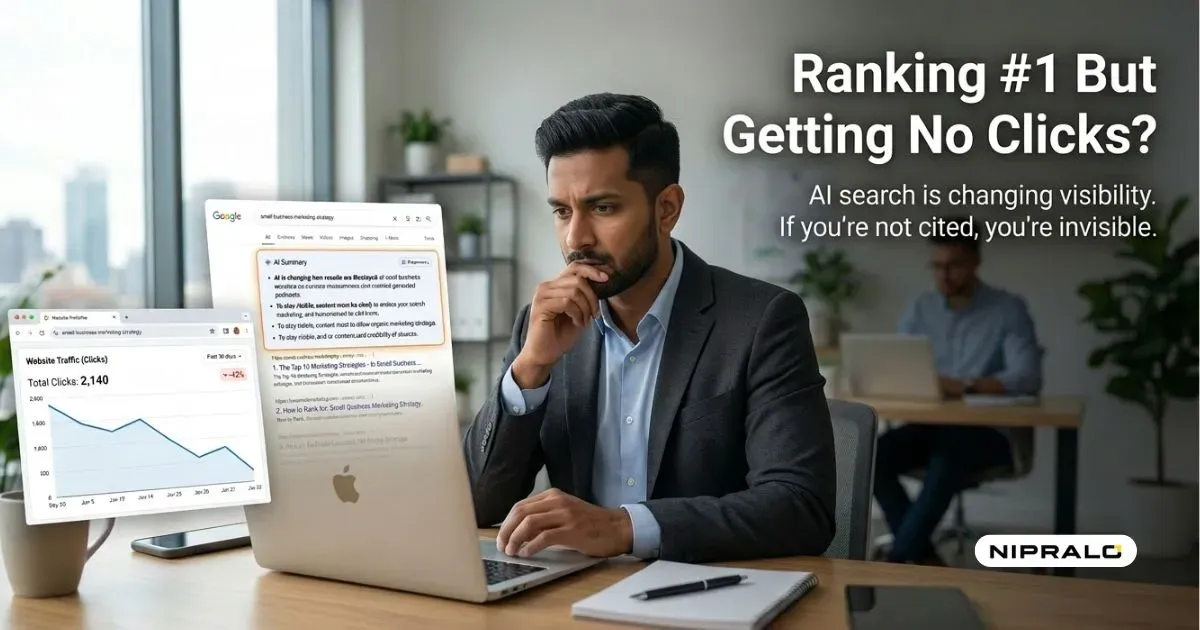
Your Google rankings look fine. Maybe even better than last month. But your analytics tell a different story. Fewer sessions. Fewer clicks. Traffic numbers sliding despite the same search volume.
This is not a glitch. It is not a Google penalty. It is a structural shift in how search works - and most businesses are still measuring the wrong thing to understand it.
Something Changed at the Top of Google
Not in your rankings. Not in your content. In what happens above your rankings.
Google now answers a growing number of searches directly on the results page. Before a user ever sees your link, they get a summary - pulled from multiple sources, synthesised, and presented in a neat block right at the top. No click required. No visit needed.
By Q1 2026, Conductor's analysis of 21.9 million searches confirmed that these AI-generated blocks now appear in over 25% of all Google queries. For informational questions - the kind that drive most content traffic - that number climbs close to 40%.
What actually happens to the click
When one of these AI blocks appears at the top of a search, the zero-click rate for that query hits 83%. Eight out of ten people get their answer without scrolling down, without seeing your link, and without visiting your site.
Seer Interactive tracked 25.1 million organic impressions across 42 organisations over 15 months. Their finding: organic click-through rates dropped 61% on queries where an AI block appeared - from 1.76% down to 0.61%. That is not a soft trend. That is a structural reset.
So Where Is the Traffic Going?
It is staying on Google. And in some cases, it is moving to AI platforms entirely.
ChatGPT now handles an estimated 12% of Google's total search volume. Perplexity processed 780 million queries in a single month in 2025. Google's own AI Mode reached 75 million daily active users by early 2026.
People are still searching. They are searching more than ever. But a growing share of those searches end inside the AI interface - not on your website.
The platforms that benefit
The AI does not generate answers from nothing. It cites sources. It pulls from websites, articles, and pages it trusts enough to reference publicly.
If your content is one of those sources, something significant happens. Seer Interactive's data confirms: brands cited inside an AI-generated answer earn 35% more organic clicks than brands on the same query who are not cited. For paid clicks, the difference is 91%.
The traffic is not disappearing. It is concentrating. A smaller number of sources get most of it. Everyone else gets the zero-click version of the results.
Two Very Different Kinds of Visibility Exist Now
Before 2024, visibility in search meant one thing: ranking. You optimised your page, climbed the results, and clicks followed.
That model still works - but it is no longer the whole picture.
[H3] Ranked but not reaching anyone
You can sit in position two for a high-volume keyword and get almost no traffic from it if an AI-generated summary appears above you and answers the question before the user scrolls. The ranking is real. The click does not happen.
Analysts are calling this the Great Decoupling - search volume goes up, organic clicks go down, and the gap between the two widens every quarter.
Cited and invisible to your analytics - but building your brand
Here is the counterintuitive part. You can get cited in an AI-generated answer without ranking in the top ten. CXL's analysis of 100 AI Overview citations found that 46.5% of cited URLs rank outside Google's top 50 for that query.
Structure and authority matter more than position. If your content directly answers a question, references reliable sources, and is easy for an AI system to extract - it has a real shot at being referenced. Even from page four.
There is also a second-order benefit worth noting. When your brand appears in an AI-generated summary, you get a credibility signal no ranking can replicate. The user reads "according to [your brand]" inside Google's own answer. That is a different kind of authority. It sticks differently.
[H2] What the AI Actually Picks Up
This is the part most content guides skip. They say "create helpful content" without explaining what helpful looks like to a system deciding whether to cite you.
Answer first, context second
CXL's citation study found that 55% of AI citations come from the top 30% of a page. The machine is not reading your full article. It is scanning for the clearest, fastest answer - and if your core answer is buried three sections deep, it often does not find it.
The practical implication is specific: put your direct answer within the first 20% of the page. Then support it. Do not build up to it with three paragraphs of scene-setting.
Structure signals that get you cited
Research cited in Averi's 2026 AI Overview guide shows LLMs are 28 to 40% more likely to cite content with clear formatting. That means proper heading structure, short factual paragraphs, FAQ sections, and content that answers one question per section without ambiguity.
Content featuring original data - your own numbers, your own case results - sees 30 to 40% higher visibility in AI responses. Generic commentary on someone else's findings does not earn citations the way specific, verifiable claims do.
Schema markup matters here too. FAQ schema and Article schema signal to Google's systems exactly what your content contains and who produced it. It reduces extraction friction, and that directly affects whether your page gets referenced.
If you want to know how your current content holds up against these signals, our team at Nipralo runs full website audits that cover both traditional SEO health and AI citation readiness. Most sites have the same three structural gaps - and they are fixable without a full content overhaul.
What This Means for How You Create Content Now
The goal has shifted. You are no longer optimising only to rank. You are optimising to be referenced.
Two things change in practice.
First, every piece of content needs a clear, direct answer to one primary question - placed early, written plainly, sourced properly. Not an SEO preamble. Not a long-winded intro. The answer, front and centre.
Second, topical authority works differently now. A single well-optimised article will not earn consistent AI citations. A cluster of interlinked content - a hub article that answers the main question, supported by spoke articles that handle every sub-question - signals to AI systems that you are the reliable source in your space.
Google's own documentation on how AI search uses website content confirms that trustworthiness and authoritativeness are the primary filters. These are the same E-E-A-T signals that have mattered in SEO for years. Now they determine AI citation eligibility too.
What to Do in the Next 30 Days
If your traffic has softened and your rankings have not moved much, this shift is almost certainly part of the picture.
Start with a five-minute check. Open an incognito browser window and search your top ten keywords. Note which ones show an AI-generated summary block before the organic results. For each one that does, check whether your brand or your content is cited inside it.
If it is not, that page needs structural attention - not a full rewrite. Move the direct answer up. Add a proper FAQ section. Reference named sources with dates. Use clean heading structure with H2s and H3s that each answer a specific question.
Then track what changes. Google Search Console now includes AI Overview impression data under the Web search type. Combine it with manual spot-checking - search your target queries monthly and record whether you appear in the generated summary.
The businesses that make these adjustments this year will have a structural advantage that compounds. AI citation authority builds the same way domain authority used to - slowly at first, then significantly.
The Google AI Overviews SEO impact is real and measurable. But it is not a content apocalypse. It is a restructure. The businesses that understand being cited is now worth more than simply ranking will pull ahead - and the gap between them and everyone else will grow every quarter.
The click is no longer the only measure of reach. The citation is.
WhatsApp our team at +91 98339 39571 - tell us your top keywords and we will check your AI citation readiness at no cost. Send us a message here
Frequently Asked Questions
How do Google AI Overviews affect my website traffic?

Google AI Overviews appear directly at the top of search results and answer user queries without requiring a click to any website. Seer Interactive's September 2025 study found that organic click-through rates dropped 61 percent on queries where an AI Overview appeared. The overall effect is fewer website visits even when search volume stays the same or grows.
How do I get my content cited in Google AI Overviews?
Place your direct answer to the main query within the first 20 percent of the page rather than building up to it slowly. Use clear heading structure, short factual paragraphs, and a FAQ section. Reference named sources with dates and use Article and FAQ schema markup to help Google's systems understand and extract your content with confidence.
What type of content gets cited in AI Overviews?
Structured, factual, and original content gets cited most consistently. Research shows that 55 percent of AI citations come from the top 30 percent of a page, meaning content that answers the question early and clearly has a significant advantage. Pages with original data or statistics see 30 to 40 percent higher visibility in AI responses compared to content that only summarises information found elsewhere.
Is SEO dead because of AI search?
SEO is not dead but it has fundamentally changed. Rankings still matter because 76 percent of AI citations come from pages already in the top ten. However, ranking is no longer the only path to visibility. Pages ranking outside the top 50 are being cited in AI responses if their content is well-structured and authoritative. The goal has shifted from ranking alone to ranking and being referenced.
What is Generative Engine Optimization and how is it different from SEO?
Generative Engine Optimization or GEO is the practice of structuring content so it gets cited inside AI-generated answers on Google, ChatGPT, Perplexity, and similar platforms. Traditional SEO optimises for rankings and clicks. GEO optimises for citations and brand mentions inside AI responses, which can reach users even when they never click through to your site. In 2026 both approaches are needed together.