
All Posts
AI Voice Agents 2026: GPT-Live, $80 Billion in Savings, and What It Means for Your Phone Line
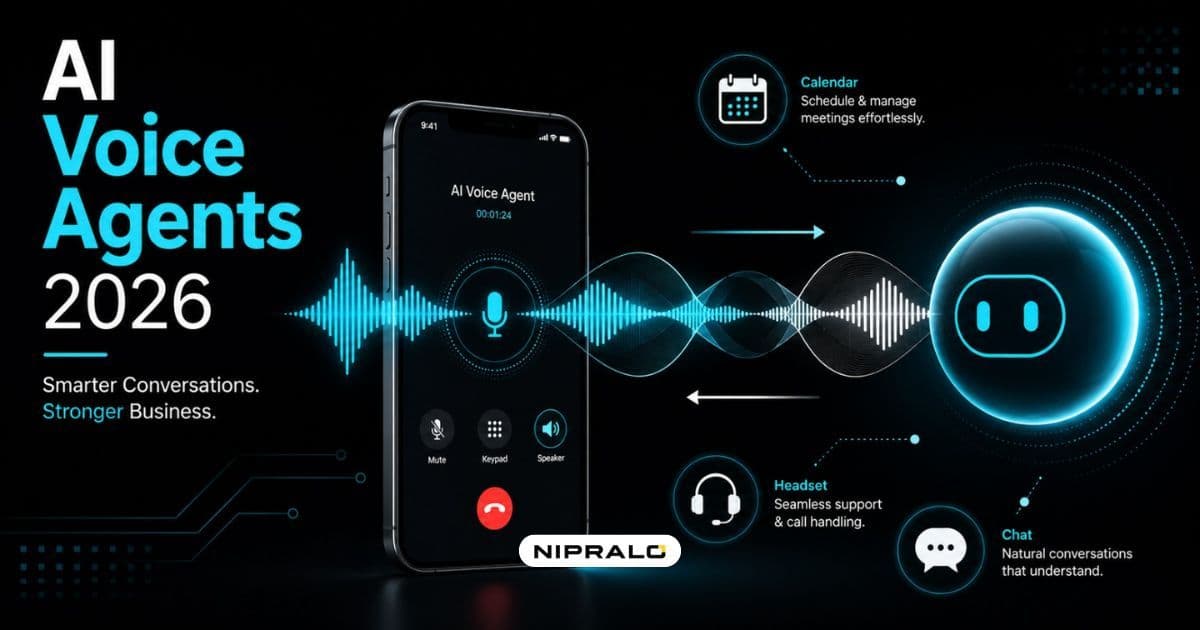
On July 8, 2026, OpenAI launched GPT-Live. It is the first mainstream voice AI that listens and speaks at the same time, like a person on a phone call. No awkward pauses. No talking over you. It even says "mhmm" while you explain your problem.
That sounds like a small thing. It is not. It removes the last reason customers hang up on AI: the robotic turn-taking. And it lands in a year when Gartner expects conversational AI to cut contact center labor costs by $80 billion.
If you run a business with a phone line, this affects you. AI voice agents for business just crossed from "interesting demo" to "this could answer my phones." Here is what actually changed, what it costs, and where the traps are.
Why AI voice agents for business just got serious
Voice AI has existed for years. Most of it was bad in the same way. The old systems worked like a relay race: your speech got converted to text, a language model wrote a reply, and a voice engine read it out. Every handoff added delay. Every pause got mistaken for the end of your sentence.
GPT-Live throws that out. It runs on what OpenAI calls a full-duplex architecture: the model processes your voice while it speaks, making decisions several times per second. Talk over it and it stops. Pause to think and it waits. Ask something hard and it quietly hands the question to GPT-5.5 in the background while keeping the conversation going.
The numbers back the feel. In OpenAI's human preference tests, people chose GPT-Live over the old Advanced Voice Mode 75.7% of the time. On the GPQA reasoning benchmark, it scored 84.2% against 45.3% for its predecessor. More than 150 million people already use ChatGPT voice features every week.
And OpenAI is not alone. Google's Gemini Live already runs full-duplex. ByteDance shipped its own version. Nvidia released one in January. This is not one company's party trick. It is the new baseline for how machines talk.
What full-duplex means on a real business call
Think about the last time you called a company's IVR. "Press 1 for sales." You shouted "AGENT" three times. That entire category of experience is now obsolete.
A full-duplex agent handles interruptions, background noise, and half-finished sentences the way a good receptionist does. A caller can say "actually wait, cancel that, I meant Thursday" mid-sentence and the agent keeps up. That single capability is what separates the 2026 generation from everything before it.
What an AI voice agent can actually do for your business
Forget the hype. Here are the four jobs where voice agents already earn their keep.
AI receptionist
It answers every call. First ring, midnight, Sunday, Diwali. It greets callers, answers common questions, books appointments into your calendar, and routes anything unusual to a human. For clinics, salons, real estate offices, and service businesses, missed calls are missed revenue. An estimated 34% of small and mid-size businesses in the US and Europe already use some form of AI phone handling, up from 11% in 2024. India is earlier on that curve, which is exactly the opportunity.
Customer support line
Order status, delivery tracking, return requests, warranty questions. Repetitive, high-volume, and soul-crushing for humans. Voice AI handles these at roughly $0.40 per call versus $7 to $12 for a human agent. A Forrester study found companies deploying voice AI saw three-year ROI between 331% and 391%, with payback in under six months.
Booking confirmations and reminders
Outbound calls that confirm appointments, verify cash-on-delivery orders, and chase no-shows. Boring work with direct money attached. One hospitality pilot cut no-show rates roughly in half with automated confirmation calls.
Lead qualification
The agent answers enquiry calls, asks your qualifying questions, and pushes clean data into your CRM. Your sales team wakes up to sorted leads instead of a voicemail backlog.
The India angle: this market is about to run hot
India's conversational AI market hit USD 653 million in 2025 and IMARC projects it will reach USD 5.9 billion by 2034, growing at over 25% a year. ElevenLabs called India one of its most important markets when it announced its expansion here in February. India-first platforms like Bolna already handle 200,000 calls a day with native support for 10+ Indian languages, including Hindi, Tamil, and Telugu.
That last part matters more than any benchmark. A voice agent that only speaks polished English fails in most Indian businesses. Your callers switch between Hindi and English mid-sentence. They speak over traffic noise from a two-wheeler. The 2026 generation of agents, built on full-duplex models and Indian-language voice stacks, is the first that can genuinely cope with that.
For a Mumbai clinic or a Pune D2C brand, the math is blunt. A front-desk hire costs ₹18,000 to ₹30,000 a month, works one shift, and takes leave. A voice agent works every shift, every language you configure, and scales to 50 simultaneous calls during a festival sale.
The honest part: what GPT-Live does not fix
We build automation systems for a living, so let us be straight about the limits.
GPT-Live is not in the API yet. Right now it powers ChatGPT's voice mode for consumers. OpenAI says API access is coming soon. Until then, business deployments run on the existing voice-agent stack: platforms and models that were already good and are improving fast. GPT-Live matters today because it resets caller expectations and shows where the whole category is going within months.
Compliance is real work. India's DPDP Act and TRAI rules apply to automated calls. Callers should know they are talking to an AI. Consent for outbound calls is not optional. Get this wrong and the cost savings evaporate into penalties.
AI fails at the edges. Angry customers, billing disputes, grief, anything requiring genuine judgment: these need humans. Every serious deployment includes a clean handoff path. The goal is not zero humans. It is humans doing only the work that needs them.
Garbage setup gives garbage calls. An agent is only as good as the knowledge base, call flows, and integrations behind it. Plugging a voice model into your phone number without that groundwork produces a confident agent that confidently gives wrong answers.
Where to start: a 5-step path that does not waste money
- Pick one phone line. Your highest-volume, most repetitive one. Usually inbound support or appointment booking. Do not start with sales negotiations.
- List your top 10 call types. Pull a week of call logs. If 70% of calls fall into predictable buckets, you have a strong automation case.
- Decide build vs managed. Off-the-shelf platforms are fast but generic. A custom integration connects the agent to your CRM, calendar, and order system so it can actually do things, not just talk. Our AI automation services sit in that second camp.
- Run a 2 to 4 week pilot with human fallback. Let the agent handle real calls, transfer anything it cannot resolve, and record everything. Judge it on resolution rate and caller drop-off, not on how nice the voice sounds.
- Measure, fix, expand. Tighten the scripts, patch the knowledge gaps, then extend to after-hours coverage and outbound confirmations.
The bottom line
AI voice agents for business stopped being a gamble this year. The technology crossed the naturalness threshold with GPT-Live, the economics were already proven, and the India market is compounding at 25% a year. The businesses that deploy in 2026 get a 12-month head start on tuning their agents while competitors are still screening demo calls.
The window where this is a competitive edge, rather than table stakes, is open now. It will not stay open long.
We have built automation and integration systems for 1000+ clients across web, mobile, and ERP. Voice is the next layer, and the groundwork is the same: clean data, tight integrations, honest scoping.
Want to know if a voice agent fits your business?
Book a free 20-min call. We'll look at your call volume, your stack, and tell you honestly whether the numbers work, and what a pilot would cost.
Frequently Asked Questions
What is GPT-Live and how is it different from ChatGPT's old voice mode?

GPT-Live is OpenAI's voice model launched on July 8, 2026. Unlike the old Advanced Voice Mode, which took turns speaking, GPT-Live uses a full-duplex architecture that listens and speaks at the same time. It handles interruptions naturally and hands complex questions to GPT-5.5 in the background while keeping the conversation flowing.
What can an AI voice agent actually do for a small business?
The four proven jobs are answering calls as a receptionist, handling repetitive support queries like order status and returns, making outbound booking confirmations and reminders, and qualifying inbound leads before they reach your sales team. It works around the clock and handles many calls at once.
How much does an AI voice agent cost compared to hiring a receptionist in India?
A front-desk hire in India typically costs 18,000 to 30,000 rupees a month for one shift. An AI voice agent usually runs 8,000 to 40,000 rupees a month depending on call volume, works 24/7, and handles dozens of calls at once. Per call, AI works out to roughly 15 to 40 rupees against 80 to 150 rupees for a human.
Can AI voice agents speak Hindi and other Indian languages?
Yes. India-focused platforms like Bolna support more than 10 Indian languages including Hindi, Tamil, and Telugu, and global players like ElevenLabs are expanding in India. The 2026 generation of agents also copes better with mid-sentence language switching and background noise, which is essential for Indian callers.
Is it legal to use AI voice agents for customer calls in India?
Yes, but with conditions. India's DPDP Act and TRAI regulations apply to automated calling. Callers should be informed they are speaking with an AI, outbound calls need proper consent, and customer data must be handled compliantly. A well-scoped deployment builds these requirements in from day one.