
All Posts
Android App Trends 2026: The Ones That Will Make or Break Your Business App
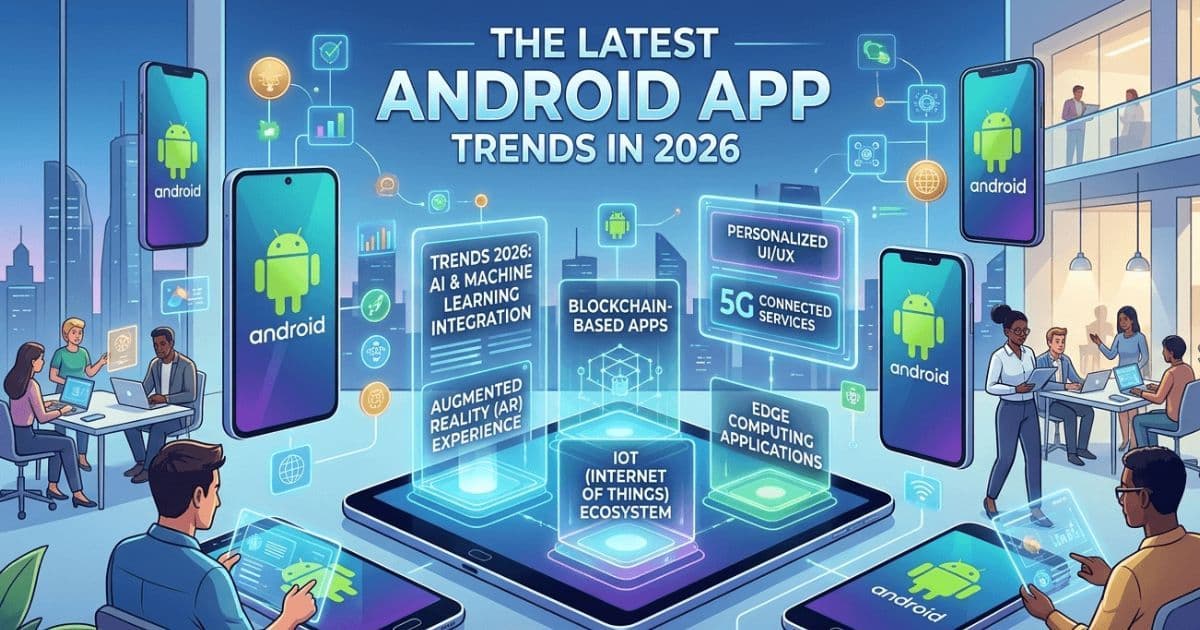
Most business owners I speak with think building an Android app is the hard part. It is not. The hard part is building one that people actually keep using.
In 2026, Android controls 95.21% of India's smartphone market. The Google Play Store is projected to hit 143 billion downloads this year. That means the opportunity is real. But so is the noise.
The Android app development trends shaping 2026 are not just technical updates. They are decisions that will determine whether your app earns a place on a user's home screen or gets uninstalled before the week is out.
Here is what is actually moving the needle.
Why 2026 Is a Different Ball Game for Android
A year ago, getting an app built was the goal. Today, the bar is higher.
India is on track to reach 1 billion smartphone users in 2026, with roughly 80% of those on 5G-enabled devices. Cross-platform frameworks like Flutter and React Native now dominate the Indian development ecosystem, especially among startups and SMBs that need to ship fast without maintaining two separate codebases.
The result is a market where good apps are everywhere. And "good" is no longer a differentiator.
What separates apps that gain traction from the ones that do not is a combination of smart technology choices, real user empathy, and a scalable foundation from day one. Let me break down the trends driving that gap.
Android App Development Trends 2026 Worth Your Attention
AI Is No Longer a Feature. It Is the Foundation.
Two years ago, adding a chatbot to your app was a selling point. Now users expect the app to feel intelligent by default.
63% of mobile app developers globally are integrating AI features into their apps. On Android, that looks like predictive search, personalised content feeds, voice-based navigation, and support bots that actually resolve issues rather than sending users in circles.
For a business, the question has shifted from "should we add AI?" to "which AI capabilities make sense for our users first?"
5G Has Changed What Is Technically Possible
With 5G now widespread across Indian metros, the old excuses about latency and bandwidth no longer hold up.
This opens the door for heavier app features: live video, real-time IoT dashboards, high-quality AR overlays, and cloud-based processing that would have been frustrating on 4G. The global AR and VR market is projected to reach $220 billion by 2026, with mobile AR contributing 37% of total revenue.
For Indian businesses, that means if your app's core use case involves real-time data, field operations, or customer-facing experiences, the infrastructure now supports features you could not justify building 18 months ago.
AR and VR Have Left the Gaming World
Augmented Reality is no longer a tool for game studios. It is showing up in retail via virtual try-ons, in real estate through property walkthroughs, in healthcare for procedure guidance, and in education through interactive 3D models.
Over 30% of top-grossing apps in 2026 are expected to include AR or VR features. For an SMB owner, that does not mean you need a full immersive experience. It does mean that if your competitor adopts even basic AR functionality in their customer-facing app before you do, you will feel the difference in engagement.
Super Apps Are Winning the Attention War
The Indian user's tolerance for switching between apps is shrinking fast.
We see this clearly in how Paytm operates: payments, shopping, insurance, and travel booking in a single place. Users do not want five apps for five needs. They want one place that handles their workflow without friction.
For businesses, this has two practical implications. If you are building a standalone app, it needs to do its core job exceptionally well to justify a home screen spot. If you are building an internal or client-facing platform, bundling adjacent features, like payments inside a field service app or document signing inside a CRM, consistently improves retention.
Privacy and Security Are Now Table Stakes
India's Digital Personal Data Protection Act is creating real compliance requirements for apps that collect user data. And users are paying more attention to what they share.
Encryption, transparent permission requests, and clear data policies are expected by both users and app stores. In 2026, apps that fail basic security checks do not just lose users. They get flagged by the Play Store directly.
Cutting corners on security during development creates expensive, reputation-damaging problems after launch.
The Real Challenges Builders and Business Owners Face
How Saturated Is Too Saturated?
The Google Play Store currently hosts over 2.06 million apps. Functionally, that means every app category already has a player in it.
The businesses that succeed in this environment are solving a specific problem for a specific user, not trying to be everything at once. When we scope a project at Nipralo, one of the first things we lock down is the one thing this app needs to do better than anything else out there. Every other feature decision flows from that.
Scalability Is a Day-One Decision, Not an Afterthought
A scenario I see repeat itself: a business launches an app, a campaign drives a spike in installs, and the servers buckle under the load. Users cannot log in. They leave and do not come back.
Scalable architecture cannot be bolted on later. It has to be a primary consideration when the app is being scoped and built. If your developer is not asking questions about expected user volume and peak traffic during the planning phase, that is a signal worth taking seriously.
What This Means If You Are Building in India Right Now
India's market has a rare combination: a massive Android-first user base, fast-improving 5G coverage, growing digital payment adoption, and a business ecosystem that is still underserved by quality apps in sectors like logistics, field services, retail, and education.
That gap is a real opportunity. But building for India in 2026 also means designing for users who are often on mid-range devices, sometimes on inconsistent networks, and have zero patience for slow load times or confusing flows.
At Nipralo, the apps we have seen perform best in reviews and retention are the ones built with this user reality in mind from the start, not adapted to it after three rounds of complaints.
Four Things We Focus On Before Writing a Single Line of Code
These are not abstract principles. They are actual checkpoints we run through with every client before development begins.
Listen first, build second. We map the actual user journey before agreeing on any feature list. If we cannot clearly describe what problem each screen solves, that screen does not belong in the first version.
Design for the actual user, not the assumed user. Clean, intuitive interfaces matter more in India's market than anywhere else. If someone needs a tutorial to understand your app, the design has failed.
Build for growth from day one. We ask every client about their 12-month and 36-month user projections during scoping. That conversation shapes the architecture choices made early on, and it prevents expensive rebuilds later.
Stay agile, but stay focused. Trends move fast. The right response is not to chase every new framework. It is to build a strong foundation and integrate new capabilities thoughtfully, when they genuinely serve the user.
Android App Trends 2026: The Bottom Line
Android app development trends in 2026 point in one clear direction: users expect more, the market is more crowded, and the technical bar is higher than it has ever been.
For Indian businesses, this is not a reason to hold off. It is a reason to be more deliberate about what you build, how you build it, and who you partner with to build it.
If you are trying to figure out whether your app idea is viable, what it should actually include, or why your existing app is not performing the way you expected, book a free 20-minute call with our team. We will give you an honest read, no sales pitch attached.
Frequently Asked Questions
What are the biggest Android app trends for businesses in 2026?

The standout trends in 2026 are AI integration, 5G-optimised features, AR/VR for customer experiences, and the rise of super apps that bundle multiple services into one. For Indian businesses, cross-platform development using Flutter or React Native is also a major consideration because it reduces build cost without sacrificing quality. The common thread across all these trends is a higher user expectation for performance, personalisation, and ease of use.
Is it worth building an Android app for my business in India right now?
Yes, for most businesses, Android is the right platform to prioritise in India because it commands over 95% of the smartphone market. That said, whether to build an app depends on whether your core use case genuinely benefits from a native mobile experience. If your customers need something they can access offline, receive push notifications from, or use in the field without a browser, an Android app is worth the investment.
How is AI changing Android app development in 2026?
AI is being built into Android apps at the infrastructure level, not just as add-on features. This means personalised recommendations, predictive search, intelligent chatbots, and on-device machine learning that improves the user experience without constant server calls. For business apps, the most practical AI use cases are customer support automation, dynamic content personalisation, and operational analytics built directly into the app.
What makes an Android app successful in a crowded market?
A successful app in 2026 solves one specific problem better than anything else in its category. Beyond that, it needs fast load times, intuitive design, strong privacy practices, and a scalable backend that holds up under real traffic. User retention data consistently shows that apps which nail a clear core use case outperform bloated apps that try to do too much at launch.
How much does it cost to build an Android app in India in 2026?
The cost depends heavily on complexity, features, and the technology stack. A basic Android app with standard features built by an Indian development team typically starts around Rs 3 to 5 lakhs. A mid-complexity app with AI features, third-party integrations, or a custom backend usually ranges from Rs 8 to 20 lakhs. The best way to get an accurate estimate is a scoping conversation where your specific requirements are mapped before any pricing is committed.