
All Posts
Claude Code vs Cursor vs Copilot: Best AI Coding Tools 2026
Published
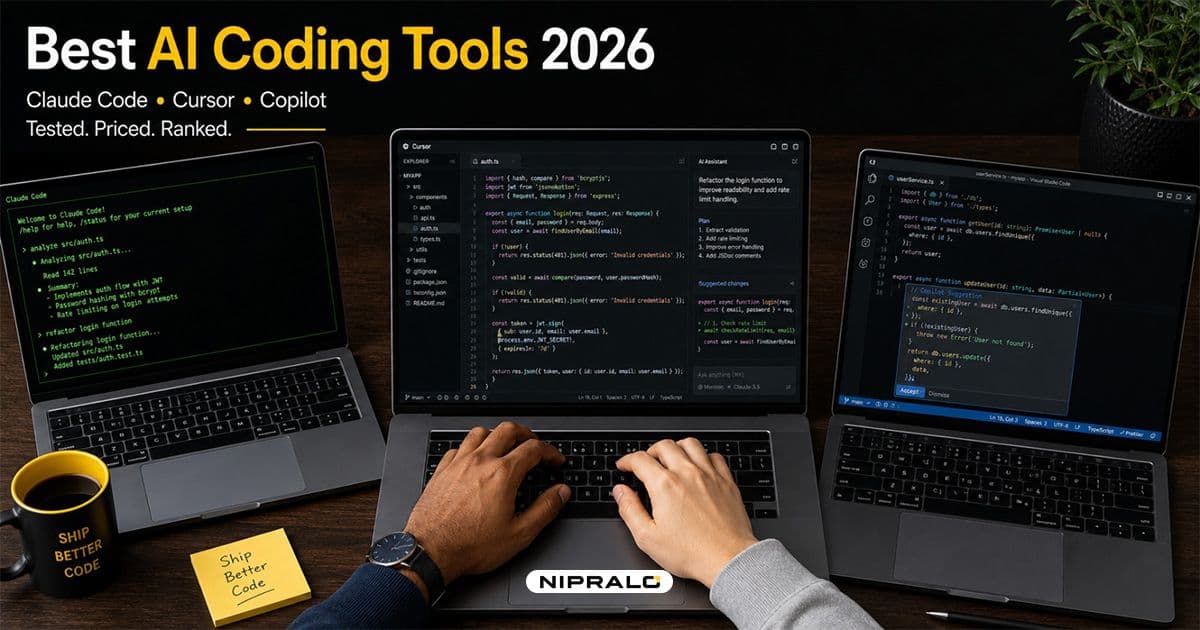
The AI coding tools market doubled in 18 months. It's roughly $12.8 billion in 2026, up from $5.1 billion in 2024, and 90% of professional developers now use one daily. We tested the three that actually matter at Nipralo: Claude Code, Cursor, and GitHub Copilot. Real client work, real codebases, real bills.
Here's the honest 2026 verdict on the best AI coding tools for business owners deciding what to pay for, and what stack to put on their team.
Before the comparisons, a quick reality check. April 2026 changed everything. GitHub paused new sign-ups for Copilot Pro and Pro+. They announced a shift to usage-based billing on June 1. Anthropic shipped Opus 4.7 with a big jump on coding benchmarks. Cursor pushed Composer 2 and parallel agents. Three weeks from now, Microsoft Build 2026 in San Francisco will probably reset the board again.
So this is a snapshot. But it's an accurate one for May 2026, and the framework holds even as the prices shift.
The short answer
If you only read one section: pair Cursor with Claude Code. Use Cursor as your daily editor at $20/month. Add Claude Code on the Pro or Max plan when you need an agent that can rewrite five files at once and not lose track. Skip Copilot unless you're already locked into a GitHub-Microsoft enterprise contract.
If you need one tool only:
- Solo dev or hobbyist: GitHub Copilot at $10/month. Still the best entry-level value.
- Working developer: Cursor Pro at $20/month. The IDE pays for itself in week one.
- Senior dev or technical founder: Claude Code on the Max plan. The agentic depth justifies the price if you live in the terminal.
The rest of this post is why we landed there, with the numbers behind each call.
Claude Code: the agent that does the heavy lifting
Claude Code is Anthropic's terminal-native coding agent. It runs in your shell, reads your codebase, edits files, runs commands, and creates pull requests. Less autocomplete, more "junior engineer who shipped something while you were in a meeting."
Anthropic released Claude Opus 4.7 on April 16, 2026. The benchmark numbers are real and we felt them. SWE-bench Verified jumped from 80.8% to 87.6%. SWE-bench Pro went from 53.4% to 64.3%. CursorBench climbed from 58% to 70%. Rakuten reported resolving 3x more production tasks than with Opus 4.6 (Anthropic's own announcement has the full breakdown).
What it does well
The 1 million token context window is the biggest practical edge. We pointed it at a 14,000-line legacy ERP module for a manufacturing client in Pune and asked it to extract a billing service. It read the whole thing, planned the refactor, executed across nine files, and ran the test suite. We did one round of cleanup. That's not a demo, that's a Tuesday.
The new self-verification behaviour matters too. Opus 4.7 actually checks its own output before reporting back. Fewer "wait, that's wrong" loops.
Where it hurts
Pricing is the catch. Claude Pro at $20/month gets you usage limits that real client work blows through fast. Power users need the Max plan, which runs $100 to $200 per month. For a small agency that adds up.
It's also terminal-first. Junior developers want a button to click. Claude Code asks them to talk to a shell. There's a learning curve, and it's real.
Single model lock-in. Anthropic only. If you want to route a task to GPT or Gemini, you're in the wrong tool.
Cursor: the editor that just works
Cursor is an AI-native IDE built as a VS Code fork. Your extensions, themes, and keybindings carry over. The AI is wired into every part of the editor: tab completions, multi-file Composer edits, an Agent mode for end-to-end tasks, and parallel background agents that handle work while you focus on something else.
By early 2026, Cursor was being used by more than half of the Fortune 500 and crossed $2 billion in annual recurring revenue. That kind of adoption from corporate buyers tells you something the marketing pages don't.
What it does well
Composer 2, released in March 2026, is the practical winner. Tell it "add password reset to these 12 endpoints, update the API routes, write the email template, and add the frontend form" and it spreads the work across the right files. We use this almost daily for feature work on client web apps and the time saving is honest, not hype.
Multi-model routing is useful in a way single-model tools cannot match. Claude Opus 4.7 for architecture work. GPT-5.5 for general coding. Gemini for cheap pass-through tasks. The same editor switches per task.
Bugbot, which graduated to a "fixer" in February 2026, reviews PRs and proposes fixes when it finds real bugs. Resolution rate is roughly 80% on simple issues. Treat it like a junior reviewer, not a senior engineer.
Where it hurts
The credit-based pricing system, introduced mid-2025, still confuses people. The $20 Pro plan gives you a credit pool that depletes faster on Claude than on Gemini. Heavy Claude users hit the ceiling and step up to Pro+ at $60/month or Ultra at $200/month.
Long agent sessions degrade. After 90 minutes of continuous work the reasoning quality drops noticeably. Restart per task and you're fine.
Performance lags vanilla VS Code on very large monorepos. Above 200K files, the indexer struggles unless you tune your .cursorignore.
What the benchmarks actually say
Benchmarks are imperfect but they're the best public signal we have. Here's where the leading models stand on agentic coding tasks as of late April 2026.
The pattern is clear. Claude Opus 4.7 leads on the hardest, most realistic coding benchmarks. SWE-bench Pro, which tests across four programming languages and is closer to production work than the curated Verified set, is where the spread is biggest. Anthropic's lead there is not noise.
But model performance is not tool performance. The tool that wraps the model matters as much as the model itself. We have seen Cursor with Opus 4.7 outperform Claude Code on UI-heavy tasks where the visual diff helps, and Claude Code outperform Cursor on long-running terminal tasks where agent persistence matters more than visuals.
Benchmarks rank the engine. Workflow fit ranks the car.
How we actually use them at Nipralo
We're a Mumbai-based digital agency working on websites, mobile apps, ERP systems, and AI automation builds. Most of our team is mid-level developers, with a few seniors leading architecture. Here's the stack we run as of May 2026.
Daily editing: Cursor Pro
Every developer on our team has Cursor Pro at $20/month per seat. It replaces VS Code, so there's zero switching cost. Tab completions and Composer handle 80% of routine feature work. Junior developers ramp up faster on Cursor than on any tool we've tested.
We standardise on Auto mode for routine work to avoid burning credits on premium models, and route complex tasks to Claude Opus 4.7 manually.
Heavy refactors and audits: Claude Code
Two senior engineers have Claude Code on the Max plan. We use it for tasks that touch many files, deep codebase audits before client handoff, large legacy migrations, and any work where the agent needs to plan, execute, and verify across an entire repo.
The Max plan is expensive. We justify it by the work it replaces, which would otherwise be 2 to 3 days of senior time per migration. The math works.
Inline completions for legacy projects: GitHub Copilot
For client projects locked into GitHub Enterprise where compliance prevents Cursor or Claude Code, we still use Copilot. Mature enterprise controls, proven IP indemnification, and the workflow integrates with the client's existing PR review tooling. We treat it as a supporting tool, not the lead.
What we tell clients
If you're hiring a development team in 2026, ask them what AI tools they use and how. Teams that say "we use AI" are often using it badly. Teams that can describe the specific tool, the specific workflow, and the specific cost per developer per month are the ones to trust.
Which of the best AI coding tools 2026 should you pay for?
Picking the right tool depends less on benchmarks and more on who is using it, on what kind of work, with what budget. A simple framework:
If you're a solo developer or technical founder
Start with GitHub Copilot at $10/month. Use it for three weeks. If you find yourself wanting more agent capability and fewer manual steps, upgrade to Cursor Pro at $20/month. Skip Claude Code unless you're comfortable in a terminal and your work involves regular multi-file refactors.
If you're running a small team (3 to 15 developers)
Standardise on Cursor Pro for everyone, $20/seat. Add Claude Code Max for one or two seniors who handle the architectural work. Total cost per developer is roughly $25 to $30 per month all-in, and the productivity lift is genuine.
If you're an enterprise
GitHub Copilot Enterprise at $39/seat is still the easiest sell to procurement. SOC 2, audit logs, IP indemnification, mature SSO. But run a 90-day pilot of Cursor Business in parallel with one engineering team. The productivity gap is large enough that the contract math often favours Cursor for senior engineers, even at twice the price.
If you're a non-technical founder evaluating dev shops
Ask three questions: What AI tools does your team use? How do you stop developers from shipping AI-generated bugs? And how do you bill clients for time saved by AI? The answers tell you whether you're hiring a 2026 agency or a 2022 one. You can see our work to see what a tool-aware team actually ships.
Three mistakes to avoid
We've seen each of these cost real money on real client projects.
Picking on benchmarks alone. Claude Opus 4.7 leads SWE-bench. That doesn't mean Claude Code is the right tool for a junior developer who needs visual diffs and inline suggestions. Match the tool to the workflow, not the leaderboard.
Underestimating cost volatility. 42% of developers in a Q1 2026 Digital Applied survey ranked cost volatility as their top pain point, ahead of model reliability. Usage-based pricing means a single agent session can blow a monthly budget. Cap usage at the team level before deploying.
Skipping human review. Roughly 48% of AI-generated code has security flaws and 75% of senior developers still review every snippet before merging. AI shifts where you spend time, it doesn't remove the need to spend it. Reviewing now beats writing for most senior engineers, by an 11.4 to 9.8 hours per week margin in early 2026 surveys.
What's coming next
Microsoft Build 2026 runs June 2-3 in San Francisco at Fort Mason. Expect a major Copilot agent refresh and probably another pricing change. If you're a Microsoft-stack shop, wait until June 4 before signing a 12-month deal.
Anthropic is likely to ship a Claude Mythos public release this year, which will widen the coding lead further. Cursor will keep building agentic tooling and is the most likely to acquire its way into JetBrains and mobile editors.
Three things to watch in the next quarter: how usage-based pricing shakes out, whether agentic security incidents become real news, and which tool wins the JetBrains and mobile market.
Working with us
If you want help picking the best AI coding tools for your business, or if you need a development team that already uses them well, we can help. We build websites, mobile apps, ERP systems, and AI automation for businesses across India and globally. Our team uses these tools every day on client work.
Book a free 20-minute call and we'll walk you through what your specific project would need, what it would cost, and what we'd actually use to build it.
Pick the right AI coding stack with help from a team that lives in it
We use Claude Code, Cursor, and GitHub Copilot every day on real client work. Tell us what you're building, and we'll tell you exactly which combination fits your team and your budget.
Frequently Asked Questions
Which is the best AI coding tool in 2026?

There is no single best AI coding tool for every developer in 2026. Most professional teams pair two: Cursor as the daily editor at 20 dollars per month, and Claude Code on the Max plan for heavy multi-file refactoring and codebase audits. GitHub Copilot remains the best entry-level pick for solo developers at 10 dollars per month, especially those already standardised on the GitHub and Microsoft ecosystem.
Is Claude Code better than GitHub Copilot in 2026?
For agentic coding work that spans multiple files, yes. Claude Code with Opus 4.7 leads SWE-bench Pro at 64.3 percent, well ahead of GPT-5.4 and Gemini 3.1 Pro. But GitHub Copilot is cheaper, easier for non-terminal users, and has more mature enterprise controls. The right choice depends on your workflow, not just the benchmark scores.
How much does Cursor cost compared to GitHub Copilot in 2026?
Cursor Pro is 20 dollars per month for individuals and 40 dollars per seat per month for teams. GitHub Copilot Pro is 10 dollars per month for individuals and 19 dollars per seat per month for Business. Cursor costs roughly twice as much, but the difference reflects a real capability gap on multi-file editing, parallel agents, and multi-model routing.
Why is GitHub Copilot pausing new sign-ups in 2026?
GitHub paused new sign-ups for Copilot Pro, Pro+, and Student plans on April 20, 2026 to manage demand on its infrastructure ahead of a shift to usage-based billing on June 1, 2026. Existing subscribers continue to have access. The change reflects how expensive long-running agentic workflows have become for the company under flat-rate pricing.
Can I use Claude Code, Cursor, and GitHub Copilot together?
Yes, and many professional developers do. Q1 2026 developer surveys found that experienced developers run an average of 2.3 AI coding tools at once. The most common stack is Cursor for daily editing, Claude Code for complex agentic work, and Copilot kept for clients or projects locked into the GitHub ecosystem.