
All Posts
Best AI for Coding in 2026: Which Model Should Your Dev Team Actually Pay For?
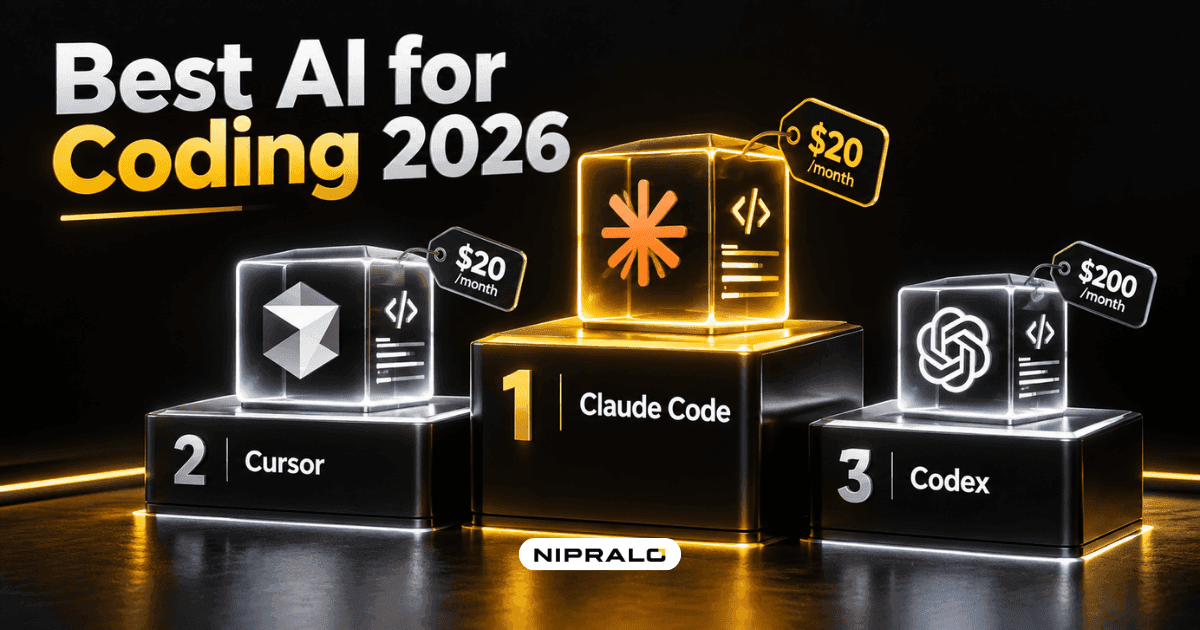
Five frontier AI models launched in the four weeks before October. The most expensive costs $50 per million output tokens. The cheapest costs 50 cents. That is a 100x gap, and both can write working code.
So the question is not just which is the best AI for coding. It is which one is worth the money for the work your team actually does.
For most teams, the answer is not the model at the top of the leaderboard. Here is the ranking, the numbers behind it, and how to pick.
Best AI for coding in October 2026: the short answer
Prices are list API rates in USD per million input and output tokens, as of late September 2026.
How we ranked them
Our team uses AI coding tools on client projects every day. But this ranking is built on published, independent benchmarks, not a single in-house test. Three things decided the order.
Agentic coding scores. We leaned on Terminal-Bench 4.0 and the Artificial Analysis Coding Agent Index. Both test whether a model can finish a real multi-step job in a terminal, not just write one function.
Cost per finished task. Not price per token. A cheap model that burns three times the tokens is not cheap.
Fit for the job. A model that is brilliant at a hard refactor can be a waste of money on routine edits.
We ignored SWE-bench Verified for ranking. It used to be the standard test, but top models now score above 90% on it. When everyone passes, the test stops telling you much.
One more warning. Sources disagree, sometimes by several points, because benchmark versions change often. Treat any single number as a signal, not a verdict.
The top tier: GPT-6 Astra, Claude Opus 5.5, Claude Fable 5.1
These three handle the hardest work: large codebases, long refactors, bugs nobody can find.
Claude Opus 5.5
The best value at the top. It posted the highest Terminal-Bench 4.0 score in Morph's September ranking at 66.4%, and it costs $4 in and $20 out per million tokens. Anthropic recommends it as the default for long-running coding work.
GPT-6 Astra
OpenAI's flagship, launched September 3. It tied Claude Fable 5.1 at 62 on the Artificial Analysis Coding Agent Index. It is also token-efficient: it matched Fable 5.1's results at about 40% of the cost per task. The list price is still $10 in and $50 out.
Claude Fable 5.1
Anthropic's most capable model, also launched September 3. It is built for the hardest reasoning and long, multi-hour jobs. It costs the same as Astra per token, but it used more tokens per task in Artificial Analysis testing. Keep it for problems the other two cannot crack.
Scores are from Morph's September 2026 ranking, so they compare like for like. DeepSeek's price is the peak-hour rate.
The workhorse tier: Claude Sonnet 5.5 and GPT-6 Sol
This is where most day-to-day coding belongs.
Both cost $2 in and $10 out per million tokens. That is one fifth of Astra or Fable. Both handle normal feature work, bug fixes, tests and refactors inside a single module without trouble.
Neither has a clean, comparable Terminal-Bench 4.0 score yet. GPT-6 Sol scored 68.8% on DeepSWE, a different agentic test. Our advice is simple: start your team here, and move a task up a tier only when it fails.
Budget and open models: good enough more often than you think
Three groups sit below the workhorses.
GPT-6 Luna at $0.10 in and $0.50 out is the cheapest serious option on the market. Use it for high-volume, simple jobs: writing docstrings, tagging issues, converting formats.
Gemini 3.8 Flash at $0.75 in and $3.75 out is fast and cheap. It scored 19.1% on Terminal-Bench 4.0, so it is not built for long autonomous tasks.
Open models are the real story of 2026. GLM 5.3, Kimi K3 and DeepSeek V4 are all released under the MIT licence. You can run them on your own servers, which matters if client code cannot leave your network. DeepSeek V4 Pro scores 80.6 on SWE-bench Verified, close to last year's best closed models.
Where is Google's flagship?
Not here yet. Gemini 3.5 Pro was announced in May for a June release. Bloomberg reported it was still delayed in August, with coding performance among the reasons. Until it ships, Google has no model in the top tier.
Price per token vs cost per task
The table everyone shares is price per token. The number that hits your invoice is cost per task.
Here is a simple illustration. Take one coding task that reads 300,000 tokens of code and context and writes 30,000 tokens back.
That math assumes every model uses the same number of tokens. They don't.
Token efficiency can reverse the order. In Artificial Analysis testing, Astra finished the same work as Fable 5.1 for $3.26 per task against $7.63. Same list price, less than half the real cost.
So run your own task, and look at the bill, not the rate card.
Which model should your dev team actually pay for?
Here is how we would set it up, by type of team.
Most teams do not pay per token at all. They pay through a coding tool like Claude Code, Cursor or Codex, on a $20 to $200 monthly plan. The model choice still matters there. It decides how fast you hit your usage limit.
A real example
Picture a five-person team in Pune building a booking app for a clinic chain. They put everyone on the top model by default. They hit their plan limits by mid-week, every week.
The fix was routing, not a bigger plan. Sonnet-class models for daily feature work. Opus 5.5 for the payment integration and one ugly migration. Luna-class models for test data and docs. Same output, and the limits stopped being a problem.
This is the approach we take at Nipralo on custom software and AI automation projects. Match the model to the job. Review everything it writes. You can see the work in our web and mobile app portfolio and case studies.
How to pick in one week
- Pick three real tasks from your backlog: one easy, one medium, one hard.
- Run each on a workhorse model first, then on one top-tier model.
- Record time to a reviewed, working result and the cost of each run.
- Set the workhorse as the default. Allow the top tier only for the task types that failed.
- Check again in three months. A new model ships almost every week.
The bottom line on the best AI for coding
The best AI for coding in October 2026 depends on the job. Claude Opus 5.5 gives the best top-tier value. GPT-6 Astra and Claude Fable 5.1 are for the hardest problems. Claude Sonnet 5.5 and GPT-6 Sol should do most of your team's daily work. And open models are now good enough to run on your own servers.
Paying for the top model by default is the most common mistake we see. It costs up to five times more and rarely ships better software.
If you want help setting this up, or you want software built by a team that already works this way, book a free 20-min call. Bring one project. We will tell you which models it needs and what it should cost to run.
Frequently Asked Questions
What is the best AI for coding right now?

As of October 2026, Claude Opus 5.5 offers the best mix of top-tier coding performance and price, with the highest Terminal-Bench 4.0 score in Morph's September ranking. GPT-6 Astra and Claude Fable 5.1 are the strongest choices for the hardest problems. For everyday coding, Claude Sonnet 5.5 and GPT-6 Sol do most of the work at a fifth of the top-tier price.
Is Claude or ChatGPT better for coding?
Both are at the top in 2026 and the gap is small. Claude Opus 5.5 led on Terminal-Bench 4.0 in Morph's ranking, while GPT-6 Astra tied Claude Fable 5.1 on the Artificial Analysis Coding Agent Index and used fewer tokens per task. Test both on a real task from your own project before you commit.
Is there a free or cheap AI that is good at coding?
Yes. GPT-6 Luna costs 10 cents per million input tokens and handles simple, high-volume coding jobs well. Open models like DeepSeek V4, GLM 5.3 and Kimi K3 are free to download under the MIT licence, though you pay for the servers to run them.
Which AI is best for coding for beginners?
A workhorse model like Claude Sonnet 5.5 or GPT-6 Sol is the best place to start. Both explain their changes clearly, handle most beginner and intermediate tasks, and cost far less than top-tier models. Use them through a coding tool or chat app on an entry-level plan.
Are open-source AI models good enough for coding?
For many tasks, yes. DeepSeek V4 Pro scores 80.6 on SWE-bench Verified, close to the best closed models from a year ago. They still trail the top closed models on long, autonomous coding jobs, but they are the right choice when code must stay on your own severs