
All Posts
AI vs Dev Team Explained: Every Cost, Hidden Gap, and When Each One Wins
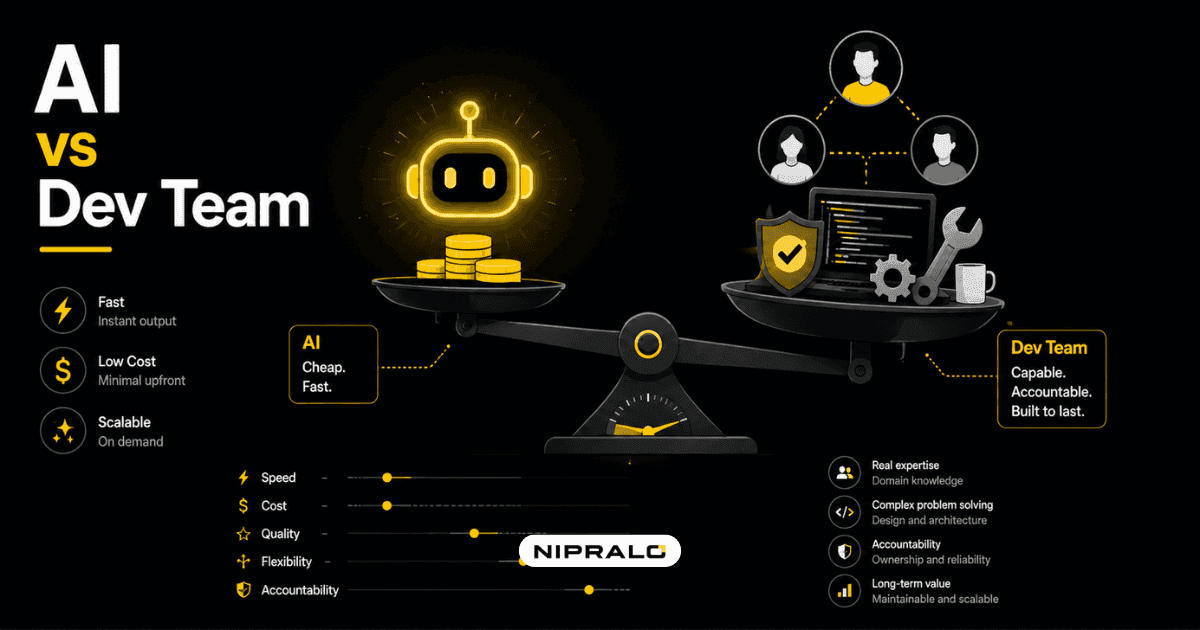
You can build a working-looking app in an afternoon now. For the price of a coffee subscription. So why would anyone still pay a development team?
That is the real question on every founder's mind in 2026, and the honest answer is not the one either side wants to sell you. AI build tools are genuinely good. They are also not the whole story. The sticker price of an AI tool is tiny. The actual cost of shipping something real is a different number, and it hides in the part nobody demos.
We build software for a living, so read this knowing our bias and judge it on whether it is fair. Because the useful framing is not AI versus humans. It is knowing exactly what each is good at, and what it really costs to use them. This post breaks down both, straight.
The costs everyone compares
Let us start with the numbers people actually look at, because on the surface it is not close.
An AI build tool like Lovable, Cursor, v0, or Bolt runs you a monthly subscription. A small monthly figure gets a non-technical person to a clickable prototype fast. A development team, whether in-house salaries or an agency, is a much larger number that buys people, process, and accountability.
If the comparison stopped here, AI wins every time. It does not stop here. But here is the surface view first.
The costs nobody puts on the slide
Here is where the real story lives. The subscription is not the cost of building software with AI. It is the entry ticket. The bill comes later, and it comes in forms that never show up on a pricing page.
The last 20% problem
AI tools get you to something that looks done fast. Roughly the first 80%. The screens, the layout, the happy path. Then you hit the last 20%, and that is where projects stall. Edge cases. Real payment handling. What happens when two users do the same thing at once. The unglamorous logic that separates a demo from a product.
That last 20% is often 80% of the actual work. And it is exactly the part AI struggles with unsupervised, because it needs judgment about your specific business, not just pattern-matching from the web.
Security and data
An AI tool will happily generate an app that leaks data, because it does not know or care what is sensitive in your business. Misconfigured access, weak auth, data exposed to the wrong users. You often do not find these until something goes wrong, and by then it is a very expensive lesson.
Scaling and rework
Code that works for ten test users can fall over at ten thousand real ones. When it does, you are often not fixing it, you are rebuilding it. The cheap prototype becomes the expensive teardown. That rework is a real cost, it just arrives three months late.
The time cost of "you fix it"
With AI, when it breaks, you fix it. That is your time, or your one technical friend's time, or a contractor you scramble to find. For a non-technical founder, that hidden time cost is often the biggest one of all, and it never appears in any comparison.
Here is the fuller picture, the one with the hidden costs added back in.
Can AI just replace a dev team?
For some things, honestly, yes. And we say that as people who build software.
If you need an internal tool, a simple landing page, a quick prototype to test an idea, or a throwaway app to validate demand before you spend real money, AI tools are excellent. Fast, cheap, good enough. Paying a team for that would be a waste, and any honest team will tell you so.
Where AI does not replace a team is the moment the thing has to be real. Real customers, real money moving, real data to protect, real load to handle. That is not a knock on AI. It is just a different job, and it is the job humans are still better at.
It is not AI versus humans
The best answer in 2026 is usually both. Our own team uses AI tools every day to move faster, generate the first pass, and skip the boring parts. Then human judgment handles the 20% that decides whether the product survives contact with real users. AI plus a team beats AI alone or a team working the slow old way. That blended approach is exactly how we build web and mobile products now.
So which should you choose?
Forget the hype on both sides. Match the tool to the stage.
- Testing an idea or building an internal tool? Use AI. Move fast, spend almost nothing, learn.
- Building the actual product customers pay for? Get a team, one that uses AI to move faster but owns the hard parts and the risk.
- Somewhere in between? Start with AI to prove the idea, then bring in a team to build the real version. That path wastes the least money.
The expensive mistake is using AI to ship a real product, watching it break under real users, and paying twice: once for the AI build, again for the rebuild. For a sense of the wider AI-tool market this sits in, a16z's writing on AI tooling is a useful read, and you can see the range of what our team ships on our services page.
The short version
On the surface, AI build tools crush a dev team on cost. Under the surface, the subscription is just the entry ticket. AI gets you to 80% fast and stalls on the last 20%, the security, the scaling, the real-world logic that turns a demo into a product. For prototypes and internal tools, AI wins outright. For the real thing customers pay for, a team that uses AI earns its cost by owning the hard parts and carrying the risk. It was never AI versus humans. The winning move is both, used for what each does best.
Not sure whether to build with AI or bring in a team?
Book a free 20-minute call. Tell us what you are building and we will tell you straight: use AI, hire a team, or start with AI and bring us in for the hard part.
Frequently Asked Questions
Is it cheaper to build an app with AI or hire developers?

On upfront cost, AI is far cheaper, often a small monthly subscription against a large team fee. But the true cost of AI shows up later in the hard last 20%, security, and scaling. For prototypes AI is cheaper overall, for a real product a team usually costs less once rework is counted.
Can AI really replace a development team?
For internal tools, simple landing pages, and prototypes to test an idea, AI tools can replace a team and paying developers would be a waste. For real products with paying customers, sensitive data, and real load, AI does not yet replace the judgment a team provides
What are the hidden costs of building with AI tools?
The subscription is only the entry ticket. Hidden costs include the stalled last 20% of the build, security and data gaps AI leaves unsupervised, rework when the prototype cannot scale, and the founder's own time spent fixing what breaks. These rarely appear in any price comparison.
When should a startup hire developers instead of using AI?
Hire a team once the product has to be real: real customers, real money moving, sensitive data to protect, or serious load to handle. A good path is to prove the idea with AI first, then bring in a team, ideally one that also uses AI, to build the version customers will actually pay for.
What can AI build tools not do yet?
AI tools struggle with the hard last 20% of a build: complex edge cases, secure data handling, real payment logic, and code that scales to thousands of real users. They also cannot carry the risk or make judgment calls about your specific business, which is where a human team still wins.