
All Posts
ChatGPT vs Gemini vs Claude 2026: 1B Users, 40% Enterprise Share, and What It Means for You
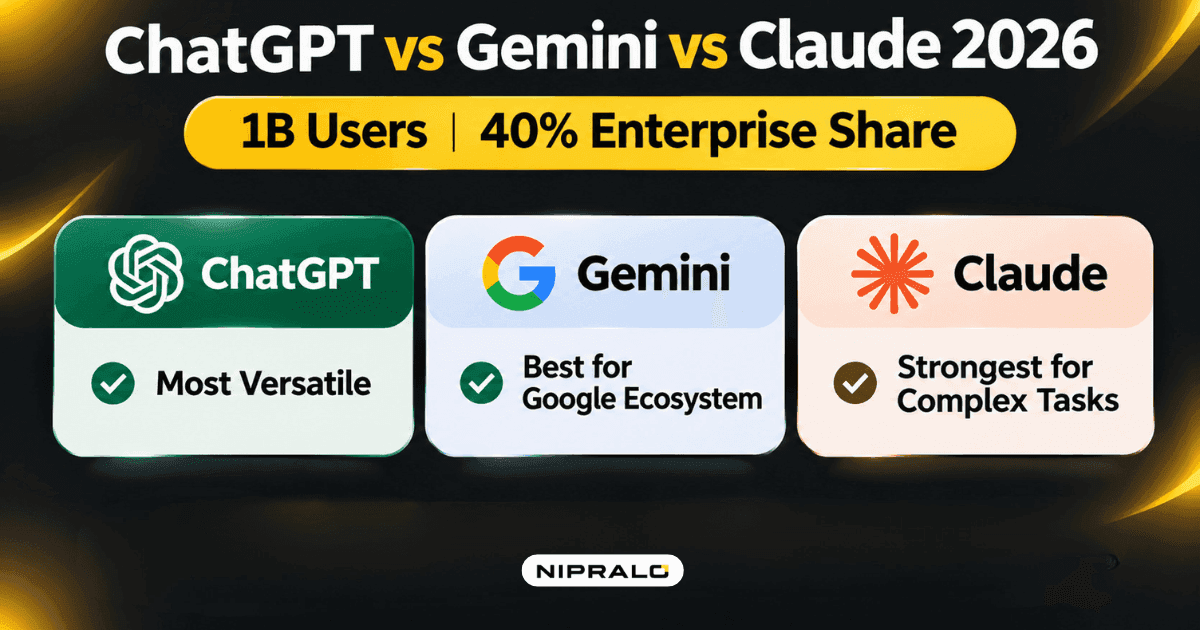
Two numbers tell you most of what you need to know about AI in 2026.
ChatGPT passed 1 billion weekly users in July. Gemini passed 1 billion monthly users in August. By popularity, it is a two-horse race.
But look at where companies spend money, and the order changes. In Menlo Ventures' December 2025 survey of US enterprise buyers, Anthropic's Claude took about 40% of enterprise AI model spend, ahead of OpenAI at 27% and Google at 21%.
The most popular tool and the one businesses pay for are not the same thing. So when you compare ChatGPT vs Gemini vs Claude for your own business, the question is not which is biggest. It is which one fits the work your team actually does.
ChatGPT vs Gemini vs Claude: the short answer
Most small businesses need one of these, not all three. Pick by the tools your team already uses and the work they do most.
What the big numbers actually mean
Two cautions. Weekly users is a stricter measure than monthly users, so ChatGPT's figure means more people use it often. And the enterprise share comes from a US survey of large companies, not Indian SMBs.
Still, the gap tells you something useful. Consumers pick the tool they already know. Businesses that pay for AI at scale, especially for coding and document-heavy work, have been choosing Claude more often.
Business plans and prices in India
All three now offer India pricing in rupees. Here is what each costs for a business.
Prices are as of mid to late 2026 and may exclude GST unless stated. Check each vendor's pricing page before buying.
The hidden advantage: Gemini comes with Workspace
If your business already pays for Google Workspace, Gemini is built into Gmail, Docs, Sheets and Meet on most plans. For many teams, that makes it the cheapest AI to roll out to everyone, because you are already paying for it.
Strengths by use case
ChatGPT: the all-rounder
The most familiar to staff, which means less training. Strong at everyday writing, brainstorming, research and quick analysis. It also covers image generation, voice and agent features in one app. If you want one tool that does a bit of everything, ChatGPT is the safe default.
Gemini: the Google Workspace option
Gemini's biggest strength is where it lives. Drafting replies inside Gmail, summarising a Meet call, cleaning up a Sheet, all without copying anything between apps. For teams that run on Google, that convenience is worth more than small quality differences.
Claude: long documents, writing and code
Claude is strongest with long, detailed work: contracts, tenders, reports, policies, and large codebases. That is a big part of why it leads enterprise spending. Menlo's mid-2025 research also put it at 42% of the enterprise coding market. The trade-off: it does not generate images or video, so creative teams will need another tool for visuals.
Is your company data safe?
This is the question business owners ask most, and the answer depends on the plan, not the brand.
On business plans, all three companies say they do not train their models on your data by default:
- OpenAI says it does not use data from ChatGPT Business, Enterprise or its API for training by default.
- Anthropic says it does not use inputs or outputs from Claude for Work or its API to train models by default.
- Google says Gemini in Workspace does not use your Workspace content to train its models.
Personal plans are different. Settings on free and individual plans vary and change over time, so check the data and privacy settings in each app. If staff are pasting client data into personal accounts, that is the bigger risk.
The simple rule: if company or client data is involved, use a business plan, not personal accounts.
Do you need all three?
Almost never. Paying for three overlapping tools for everyone is one of the most common AI mistakes small businesses make.
A better pattern is one main tool for everyone, plus a second one only for the people who need it.
Picture a 15-person CA firm in Pune that already runs on Google Workspace. Everyone uses Gemini inside Gmail and Docs, which comes with the plan they already pay for. Two partners who review long GST notices, contracts and audit files get Claude Team seats as well. Total extra cost: two seats, not fifteen.
The same thinking applies when AI goes inside your own software. Our team at Nipralo builds AI automation and custom software that uses whichever model fits each task, often more than one, so you are not locked into a single vendor. You can see examples in our case studies and web and mobile app portfolio.
How to choose in five steps
- Check what you already pay for. If you are on Google Workspace, start with Gemini.
- List your team's top three AI jobs. Emails and posts, long documents, data, code or visuals.
- Match the jobs to the strengths above. All-round daily use points to ChatGPT. Long documents and code point to Claude. Work inside Gmail and Docs points to Gemini.
- Run a two-week trial with three or four staff, on real work, not test prompts.
- Roll out one tool on a business plan, and add a second only for the roles that clearly need it.
The bottom line on ChatGPT vs Gemini vs Claude
ChatGPT vs Gemini vs Claude is not a contest with one winner in 2026. ChatGPT is the most familiar all-rounder. Gemini is the easiest choice for teams on Google Workspace. Claude leads where businesses spend most on AI: long documents and code.
Pick the one that fits your tools and your work, put company data on a business plan, and add a second tool only where it earns its place.
Want help choosing, or building AI into your own systems? Book a free 20-min call. Tell us how your team works today, and we will tell you which AI fits, and where it will actually save time.
Frequently Asked Questions
Which is better for business: ChatGPT, Gemini or Claude?

It depends on your tools and work. ChatGPT is the most familiar all-rounder, Gemini is the easiest choice for teams already on Google Workspace, and Claude is strongest at long documents, contracts and code. Most small businesses should pick one main tool rather than paying for all three.
Is Gemini included in Google Workspace?
Yes, on most Google Workspace business plans. In India, the Starter plan at about 270 rupees per user includes Gemini in Gmail, and the Standard plan at about 1,080 rupees per user adds Gemini in Docs, Meet and other apps. If you already pay for Workspace, Gemini may cost nothing extra.
Is my company data safe with ChatGPT, Gemini or Claude?
On business plans, OpenAI, Anthropic and Google all say they do not train their models on your data by default. Personal and free plans have different settings that can change, so check them in each app. If company or client data is involved, use a business plan rather than personal accounts.
Which AI is best for writing, coding or data analysis?
ChatGPT is a strong all-rounder for everyday writing and data analysis. Claude is strongest for long documents and coding, and leads enterprise coding use. Gemini is best when the work happens inside Gmail, Docs or Sheets. For images and video, use ChatGPT or Gemini, since Claude does not generate them.
Should a business pay for more than one AI tool?
Usually not for everyone. A better pattern is one main tool for the whole team, with a second tool only for the people whose work clearly needs it. This keeps costs down and avoids paying for overlapping features.