
All Posts
Claude Opus 4.8 Explained: Fast Mode, Parallel Agents, and Every Upgrade Over 4.7
Anthropic shipped a new flagship AI model 41 days after the last one. Same price. And if you opened it on day one, you might not even notice the difference.
That is the strange thing about Claude Opus 4.8. It is not a giant leap. Anthropic itself calls it "a modest but tangible improvement" over Opus 4.7. So why should a business owner care?
Because the upgrades that landed are not about raw intelligence. They are about speed, cost, and reliability. The boring stuff that decides whether AI is safe to put in front of a customer or trust with real work. This is our honest Claude Opus 4.8 review, written for owners and decision-makers, not engineers.
We build custom websites, apps, and AI automation for a living. So we judge any model by one question: does it make the work cheaper, faster, or safer? Here is what changed, what it costs, and whether it earns a place in your stack.
What Claude Opus 4.8 is, and why the timing matters
Claude Opus 4.8 is Anthropic's most capable generally available model. It launched on May 28, 2026. "Opus" is the top tier, sitting above the cheaper Sonnet and Haiku models that are built for high volume.
The release date says a lot. Opus 4.7 had shipped just six weeks earlier. Anthropic is not waiting for huge generational jumps anymore. It is pushing small, targeted upgrades fast.
For you, that means one thing. Stop waiting for "the next big AI." Versions now land close enough together that you judge each one on its own, on what it does for your actual work.
The benchmark scores, in plain English
Benchmarks are the tests AI labs use to compare models. They are useful, but only if you know which ones map to real work. Here are the numbers that matter, with Opus 4.7 alongside for comparison.
The pattern is clear. Opus 4.8 is better at coding and computer tasks, roughly flat on pure knowledge quizzes, and far stronger at math. The jump on SWE-bench Pro, from 64.3% to 69.2%, is the one to watch. That test is the closest thing to real engineering work: fixing actual bugs in actual codebases. On that same test, Opus 4.8 sits more than ten points ahead of OpenAI's GPT-5.5.
One score slipped. GPQA Diamond, an expert science quiz, dipped from 94.2% to 93.6%. Tiny, and not something you would feel in daily use. Math went the other way, hard, climbing from 69.3% to 96.7% on a tough olympiad set.
But scores are not the real story. The upgrades that change how you actually work are these three.
The three upgrades that actually change your workflow
Fast mode: the same model, 2.5x quicker
Opus is powerful but slow. Fast mode fixes that. It runs the same Opus 4.8 at about 2.5 times the speed for double the per-token price.
Here is the part that matters. Fast mode is now three times cheaper than it was on earlier Opus models. So if you run a customer-facing chatbot or a support tool where waiting feels painful, keeping a frontier model snappy is finally affordable. It is in early preview with a waitlist, so not everyone has access yet.
Parallel agents: many workers instead of one
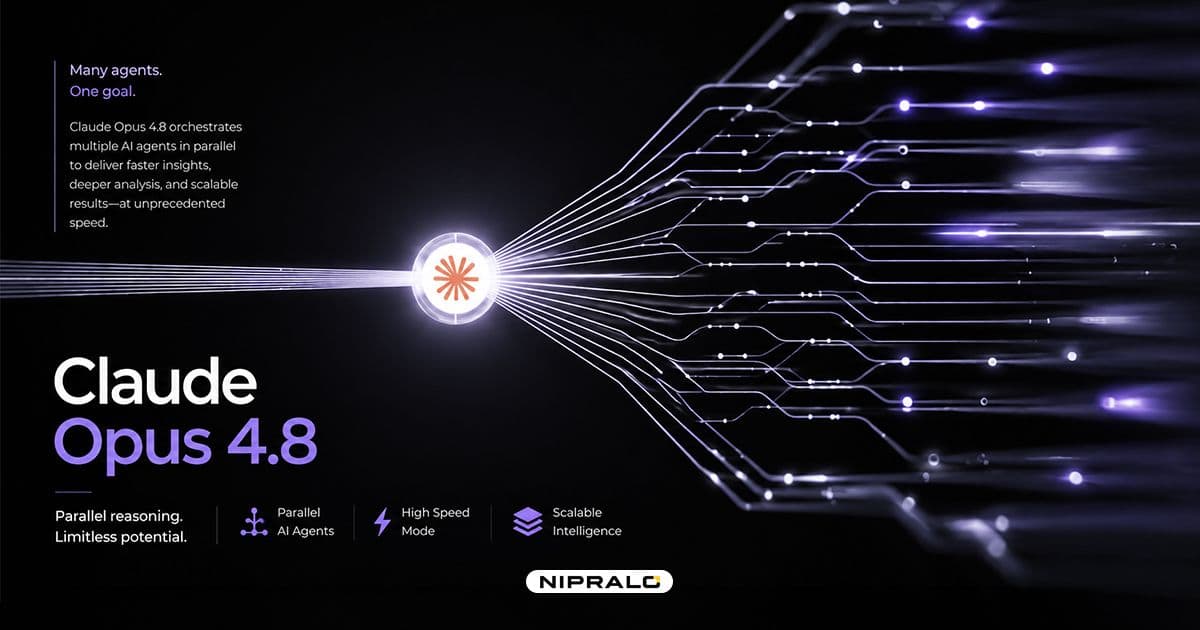
This one is for the big jobs. Inside Claude Code, Opus 4.8 can now split a hard task across hundreds of "subagents" working at the same time, each handling a slice and checking its own work before reporting back.
Think of it as the difference between one person reading a 500-page contract and a whole team splitting it up. For large jobs like migrating an old system or reworking a big app, this turns a slow grind into parallel effort. If you pay a development team, this is the upgrade that quietly saves hours.
Honesty: it stops pretending the code works
This is the upgrade we care about most. Older models had a bad habit. They would declare a job done when it was not, leaving broken code unflagged. By Anthropic's own measure, Opus 4.8 is about four times less likely to ship code with hidden flaws.
In plain terms, it tells you when it is unsure. It catches its own mistakes and pushes back when a plan is weak instead of charging ahead. For anyone letting AI run with less hand-holding, fewer silent errors means less rework and less risk. That is worth more than a point on a leaderboard.
There is a quieter win too. Opus 4.8 uses about 35% fewer output tokens than before to reach a better answer, and its default effort setting is lower while still scoring higher. Less waste, same result.
A few smaller upgrades, and where you can use it
A handful of changes did not make headlines but still matter:
- Effort is now a dial. The default is "high," with "extra" and "max" settings for the hardest problems, so you only pay for deeper thinking when you need it.
- On the developer API, you can send the model a new instruction mid-task, so it can adjust course without starting over.
- It is almost everywhere. You can use Opus 4.8 in the Claude app on Pro, Max, Team, and Enterprise plans, in Claude Code, through the API, and inside AWS, Google Cloud, Microsoft, and GitHub Copilot.
One honest footnote. Anthropic has an even stronger model, Claude Mythos, that tops the same coding leaderboard at 93.9%. But it is not available to the public. So Opus 4.8 is the best model you can actually buy today.
What Claude Opus 4.8 costs
Here is the line most buyers like. The price did not move. Standard rates match Opus 4.7 and have held since Opus 4.5. For a frontier upgrade, that is rare.
A few things to know around that table. Caching can cut your input cost by up to 90% if your app keeps re-reading the same context, which most agents do. Batch processing is half price for jobs that are not urgent, like overnight reports. And if your data has to stay in the US, expect a small surcharge.
Now the honest catch. By output rate, Opus 4.8 is one of the most expensive frontier models on the market. It can also be a little wordy, and some testers found it takes more back-and-forth turns than rivals to finish agent tasks, which eats into the per-token savings.
So Opus is not the right answer for everything. For simple, high-volume work, like tagging thousands of support tickets, a cheaper model earns its place. Opus is for the hard, high-value jobs where getting it right matters more than the bill. We help clients draw that line whenever we build AI automation into their systems.
Claude Opus 4.8 vs GPT-5.5 vs Gemini: which one for your business
No model wins at everything. Here is how the three big names stack up on what a business cares about: price, context size, speed, and what each does best.
So should you upgrade?
If you are already on Opus 4.7, this is easy. For most teams the switch is a one-line change, with the same context window and tools and no breaking changes. You get better coding, fewer silent mistakes, and the new features at the same price. Little reason to wait.
If you are on a cheaper model or a rival, the question is different. Do you actually need frontier power? If your work is mostly simple and high-volume, probably not yet. If it is complex, high-stakes, or you are building agents that run with little supervision, Opus 4.8 is the safer engine.
And if you have not put AI to work at all, do not start by picking a model. Start with the problem you want solved, then match the tool to it. Most businesses get that order backwards.
Is Claude Opus 4.8 worth it?
For coding-heavy teams, agent builders, and anyone doing high-value knowledge work, yes. The reliability and honesty gains alone cut down on rework. For simple, high-volume tasks, a cheaper model is the smarter spend.
Claude Opus 4.8 review: our verdict
Here is the short version of our Claude Opus 4.8 review. It is not a leap, and it does not need to be. It is a steady, well-judged upgrade that is cheaper to run fast, better at owning its mistakes, and strong on the hard jobs. The flat price seals it.
But a model is only as good as what you build around it. The companies winning with AI are not the ones chasing every release. They are the ones who wired one good model into a real workflow that saves real time. That is the work our team does, from the websites and apps we build to the automation behind them. For the official details, see Anthropic's announcement and its pricing page.
If you are weighing how to put a model like Opus 4.8 to work in your business, that is exactly where we can help.
Want to put AI like Opus 4.8 to work, the right way?
Book a free 20-minute call. We will look at where a model like Claude Opus 4.8 fits your business, and where a cheaper option does the job just as well. No jargon, no hard sell.
Frequently Asked Questions
Is Claude Opus 4.8 worth it?

For coding-heavy teams, agent builders, and high-value knowledge work, yes. The reliability and honesty improvements cut down on rework, which often saves more than the token cost. For simple, high-volume tasks, a cheaper model like Sonnet or Haiku is usually the smarter choice.
How much does Claude Opus 4.8 cost?
Standard pricing is five US dollars per million input tokens and twenty-five dollars per million output tokens, unchanged from Opus 4.7. A faster mode runs at double those rates for about 2.5 times the speed. Prompt caching can cut input costs by up to ninety percent, and batch processing is half price.
Is Claude Opus 4.8 better than GPT-5.5?
It depends on the job. Opus 4.8 leads on hard real-world coding and on long-document and agent reliability, scoring more than ten points ahead of GPT-5.5 on the toughest coding test. GPT-5.5 is faster, more token-efficient, and wins on command-line tasks. For complex coding and agents Opus 4.8 is the safer pick, while GPT-5.5 can win on speed and cost.
What is new in Claude Opus 4.8 compared to 4.7?
The biggest changes are a cheaper fast mode, parallel agents that split big jobs across many workers, and a large gain in honesty so the model flags its own mistakes instead of declaring a job done. It also codes better, handles math far better, and uses fewer tokens to get there. The price stayed the same as Opus 4.7.
What is Claude Opus 4.8 best at?
Coding, running multi-step agents with little supervision, and reasoning over long documents and complex sources. It is built for hard, high-value work where accuracy matters more than the bill. For simple, high-volume tasks, a cheaper model is the better fit.