
All Posts
Digital Transformation Roadmap: A Step-by-Step Guide for SMEs & Manufacturers
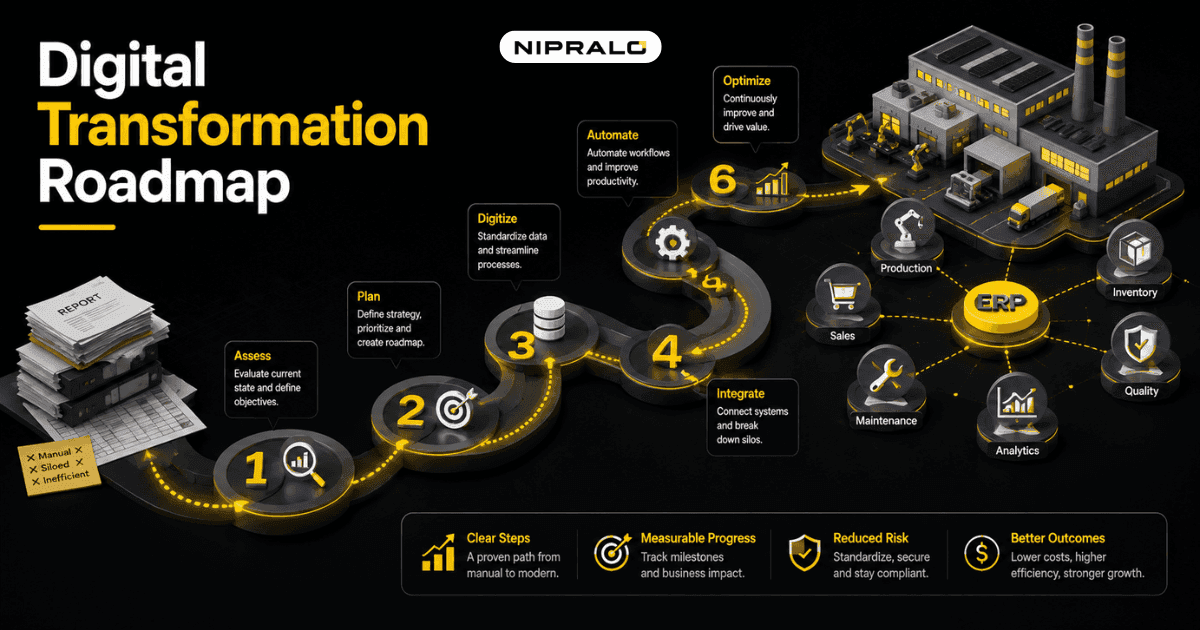
Most digital transformation projects fail. Not some. Most.
The figure that gets quoted, traced back to McKinsey and BCG, is around 70%. Seventy percent of the money, time, and hope, gone, usually with little to show for it. And the reason is almost never the technology. It is that there was no plan. Someone bought software in a panic, bolted it onto a broken process, and called it transformation.
This is the opposite of that. A roadmap. What to do, in what order, so the money you spend actually moves the business. Written for SME owners and manufacturers who are done with buzzwords and want a plan they can follow. This guide walks the whole thing, from the first honest audit to the point where the work sustains itself.
What a digital transformation roadmap actually is
A digital transformation roadmap is a sequenced plan for moving your business from manual, disconnected ways of working to digital, connected ones. The key word is sequenced. It is not a shopping list of tools. It is an order of operations.
The order matters more than the tools. Buy an ERP before you understand your own process, and you have just digitised the chaos. Now the mess runs faster and costs more. A roadmap forces you to fix the thinking before you spend on the tech.
Why "just buy the software" fails
Software does not fix a broken process. It locks it in. If your stock counting is a mess on paper, it will be a mess in the system, only now three departments depend on it and nobody can explain how it works. That is why so much transformation spending disappears with no return. The plan came after the purchase, if it came at all.
Here is the roadmap at a glance, then we walk each phase.
Step 1: Audit how work actually happens
Before you buy anything, map reality. Not how the process is supposed to work. How it actually works, mess and all.
Walk the floor. Sit with the people doing the job. Write down every step, every spreadsheet, every WhatsApp group holding the operation together with tape. You will find duplicated work, data re-entered by hand three times, and steps nobody can explain. That is the raw material.
For a manufacturer, this means tracing an order from the moment it lands to the moment it ships. Where does it wait? Where does someone copy a number from one sheet to another? Those gaps are where transformation pays.
What to look for
- Steps done twice, or by hand, that a system could do once
- Data living in people's heads or personal spreadsheets
- Points where things wait, get lost, or need chasing
- Reports that take hours to build every week
Step 2: Set goals you can actually measure
"Go digital" is not a goal. It is a wish. A goal has a number attached.
Turn the pain from your audit into targets. "Cut order processing time from three days to one." "Halve the errors in monthly stock counts." "Kill the six hours a week spent building that report." Numbers like these tell you what to build and, later, whether it worked.
Vague goals are how projects drift and budgets vanish. A measurable goal is a leash on the spending. If a tool does not move one of your numbers, you do not buy it.
Step 3: Prioritise by impact, not by hype
You cannot do everything at once, and trying is how transformations collapse. Rank your fixes.
Score each one on two things: how much it would help, and how hard it is to do. The sweet spot is high impact, low effort. Start there. It builds momentum and buys you trust for the harder work later.
Ignore what is trendy. AI, IoT, dashboards, all of it can wait if a simpler fix saves more money faster. The goal is business results, not a stack that looks impressive.
Step 4: Pilot one process end to end
Do not transform the whole business at once. Pick one process, the highest priority from Step 3, and take it fully digital, start to finish.
One process, done properly, teaches you more than ten half-finished ones. You learn how your people react, where the tool falls short, and what the real cost is. And when it works, you have proof. A working pilot turns sceptics into believers faster than any pitch.
For a manufacturer, a good first pilot is often inventory or order tracking. Contained, painful when it goes wrong, and easy to measure. Get one right and the case for the next one makes itself.
Why pilots beat big-bang rollouts
- Lower risk. If it fails, you lost one process, not the company.
- Real learning. You find the problems on a small scale, cheaply.
- Proof for buy-in. Numbers from a real pilot beat promises from a slide deck.
Step 5: Integrate, then add ERP and automation
Once a pilot works, connect things. This is where an ERP earns its place, tying orders, stock, production, and accounts into one source of truth instead of a dozen disconnected sheets.
The point of integration is that data flows once and everyone sees the same picture. An order comes in, and stock, production, and invoicing all update together. No re-entry, no version that is three days old, no arguments about whose spreadsheet is right.
For manufacturers, this is also where basic automation and connected machines start to pay, reporting from the shop floor, alerts when a line stalls, live production numbers. This is the heart of the work. Building the right custom ERP and systems for how your business actually runs, rather than forcing your business to bend around generic software, is where most of the value lives.
Build vs buy
Off-the-shelf ERP is faster to start but forces your process into someone else's mould. Custom-built fits your exact workflow but costs more upfront. For many SMEs and manufacturers with a genuinely specific process, a tailored build pays back because people actually use it. You can see the range of what our team builds on our web and app work.
Step 6: Train people and keep improving
The best system on earth is worthless if your team works around it. This step decides whether the whole roadmap sticks.
People resist new tools when they do not understand them or feel forced. So bring them in early, from the audit onward, and train properly when you roll out. A team that helped shape the system defends it. A team that had it dropped on them undermines it.
And transformation never really ends. Once one process is solid, go back to your priority list and take the next one. Small, steady steps beat one giant leap every time.
Where should you start?
If you are staring at all six steps and feeling stuck, start where it hurts most. The process that wastes the most time, causes the most errors, or gets chased the hardest. Audit that one honestly, set a number, and pilot the fix. Momentum comes from one clear win, not from a grand plan you never begin. For the strategic framing behind all this, McKinsey's digital transformation research is a solid reference.
The short version
A digital transformation roadmap is an order of operations, not a shopping list. Audit how work really happens. Set goals with numbers. Prioritise by impact. Pilot one process. Integrate and add ERP or automation once the pilot works. Train your people and keep going. Most projects fail because they skip the plan and buy the tools. Do it in order, and you land in the minority that actually works.
Not sure where your transformation should start?
Book a free 20-minute call. Our team will look at how your business runs today and map the first practical step, whether that is an ERP, automation, or just fixing one broken process.
Frequently Asked Questions
What is a digital transformation roadmap?

A digital transformation roadmap is a sequenced plan for moving a business from manual, disconnected ways of working to digital, connected ones. The important part is the order. It sets out what to fix and build, in what sequence, so spending produces real results rather than a pile of unused tools.
What are the steps in a digital transformation roadmap?
Six steps. Audit how work actually happens, set measurable goals, prioritise fixes by impact and effort, pilot one process end to end, integrate systems and add ERP or automation, then train people and keep improving. Doing them in order is what separates success from wasted spending.
Why do most digital transformation projects fail?
Research from McKinsey and BCG puts the failure rate near 70%, and the cause is rarely the technology. It is the lack of a plan. Businesses buy software in a panic and bolt it onto a broken process, which just digitises the chaos instead of fixing it.
How much does digital transformation cost for an SME?
It varies widely with scope, but the smart approach controls cost by phasing the work. You pilot one process first rather than buying everything at once, which limits risk and spreads spending. Custom-built systems cost more upfront than off-the-shelf tools but often pay back because people actually use them.
Where should a manufacturer start with digital transformation?
Start where it hurts most, usually inventory or order tracking. Trace an order from arrival to shipping, find where things wait or get re-entered by hand, and pilot a digital fix for that one process. A contained, measurable first win builds the case and the momentum for the next step.