
All Posts
ERP Software for Small Business 2026: Which One Should a First-Time Buyer Actually Use?
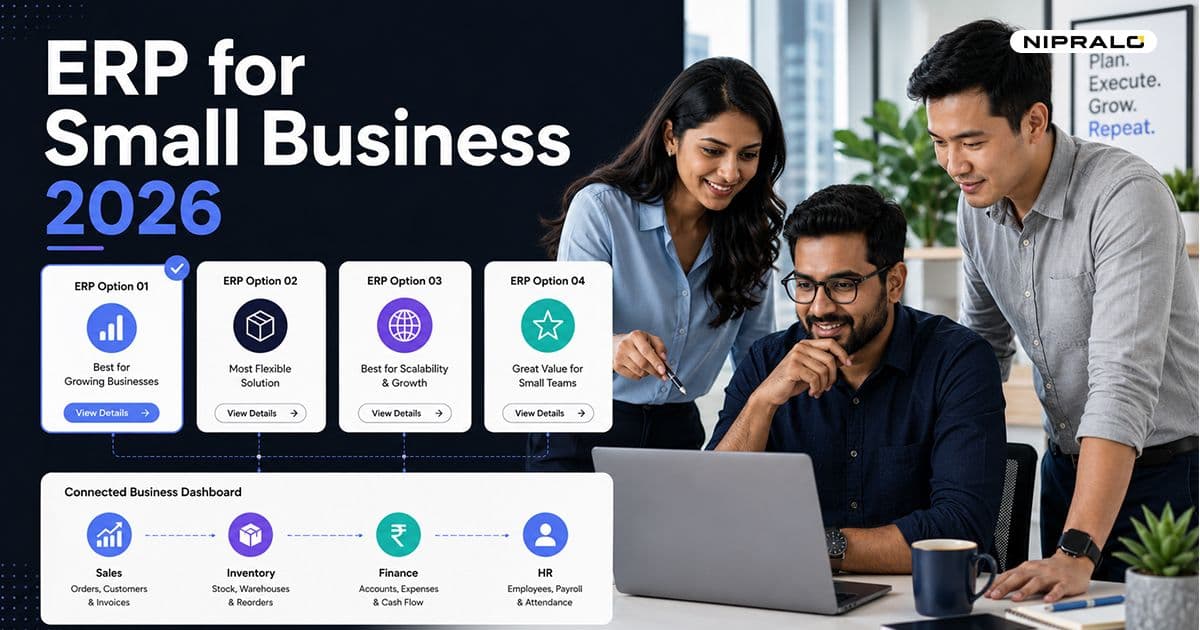
Here's the number nobody selling you ERP will lead with. Between 55% and 75% of ERP projects fail to meet their goals, and the average one runs about 189% over budget.
Read that again. Most buyers spend roughly triple what they planned, and the majority still don't get what they wanted.
Most guides to ERP software for small business buyers skip that part. We won't. Because if you're shopping for your first system, that stat should change how you shop. Not scare you off. Just change how you shop.
The problem is rarely the software. It's picking the wrong fit, scoping it badly, and trusting a sales demo over your own workflow.
This guide cuts through it. We'll show you which systems actually suit small businesses in 2026, what they really cost in India, and the one question that decides whether you buy off-the-shelf or build your own.
Do you even need an ERP yet?
Short answer: maybe not.
If you're running the whole business on a few spreadsheets, WhatsApp, and Tally for accounts, and it genuinely works, you don't need ERP. You need it when the gaps between your tools start costing you money.
The classic signal: someone spends hours every week copying data from one app into another. Sales doesn't know what's in stock. Accounts hears about a big order three days late. That's the pain ERP solves.
ERP just means one connected system for the stuff that runs your business: sales, inventory, purchasing, accounting, sometimes HR and production. One place, one version of the truth, instead of five apps that don't talk.
There's a real adoption gap here too. Across the EU, 86% of large firms run ERP but only 38% of small ones do. Small businesses are the segment racing to catch up, which is exactly why so many are buying blind.
The ERP software for small business shortlist
If you've decided you need one, start with this. These are the systems most Indian SMBs actually shortlist in 2026, with honest pricing and the catch for each.
Which one is right for you?
The table gives you the map. Here's the reasoning behind each pick, so you can match it to your business instead of guessing.
Zoho One: the safe default for service businesses
If you don't manufacture or move physical goods, Zoho One is usually the easiest, cheapest place to start. It bundles sales, finance, HR, and more into one suite with strong India compliance for GST and e-invoicing. The catch: it's built to be generic, so deep or unusual workflows will feel like a squeeze.
Odoo: flexible, but watch the bill
Odoo is the favourite when you've outgrown basic tools and want room to customise. A small business can go live in 30 to 60 days, with setup in India typically running ₹90,000 to ₹2,75,000. The honest warning: every bit of custom work adds cost, and "just one more module" is how Odoo budgets quietly double.
ERPNext: free to licence, not free to run
ERPNext is open source, so the software licence is effectively zero. That's genuinely attractive for bootstrapped teams. But free licence is not free system. You still pay for hosting, setup, and either a technical person in-house or an implementation partner. Without that, it stalls.
Tally and Busy: great accounts, not an ERP
Millions of Indian businesses run Tally, and it's excellent at accounting and GST. It is not a full ERP. The moment you need connected inventory, sales, and operations in one flow, you'll hit its ceiling, and migrating off it later costs more than starting right.
SAP Business One and NetSuite: usually overkill
These are serious, capable systems. They're also 3 to 5 times more expensive than Zoho or Odoo and take roughly 3 times longer to implement. For a 10 to 40 person business, that's paying enterprise prices for capacity you won't touch for years.
Custom ERP: when nothing off-the-shelf fits
Sometimes the way you work is the whole advantage, and no product matches it. A Mumbai garment exporter we worked with had a costing and job-card process so specific that every off-the-shelf demo broke on day one. A custom build mapped to their actual floor, and data-entry time dropped by hours a week. That's the case for custom ERP development: not because custom is better, but because forcing your business into the wrong box is worse.
Off-the-shelf or custom: the one question that decides it
This is where most first-time buyers freeze. The deciding question is simple: does a ready-made system fit how you already work, or would you have to change your business to fit the software?
Use this to settle it.
Most small businesses should start off-the-shelf and only move to custom once they hit clear, repeated limits. There's no prize for building from scratch when a ₹15,000-a-year tool would have done the job.
Why most ERP projects fail
The failure rate isn't about bad software. It's about three things, and you can avoid all of them.
First, scope. Teams buy on a polished demo, then discover the system can't do the one thing their business actually depends on. Only about 7% of organisations run ERP exactly as sold; roughly 93% need some customisation. Plan for that from day one.
Second, the real cost. The licence fee vendors quote is often just 20 to 30% of what you'll actually spend. Implementation, data migration, and training are the rest. Budget for the whole thing, not the sticker.
Third, adoption. By some estimates only around a quarter of employees actively use an ERP after go-live, and a large majority of CIOs blame staff resistance for failed projects. A system nobody uses is worse than no system.
How to actually pick your ERP in 2026
Here's the order we'd run it in for any small business choosing for the first time.
- Map your real workflow. Write down how work flows through your business today and exactly where data gets stuck between tools. This document, not a brochure, drives every later decision.
- Confirm you need ERP. If disconnected apps are costing you real time and money, you're ready. If spreadsheets still work fine, wait and save the cash.
- Shortlist by fit, not brand. Match systems to your processes and industry. The biggest name on the list is rarely the right one for a 20-person team.
- Check the total cost. Add implementation, migration, and training to the licence. Remember the licence is often only a fifth of the real spend.
- Decide off-the-shelf or custom. Buy ready-made for standard needs and speed. Build custom only when your workflow genuinely doesn't fit any product.
Do those five honestly and you've already dodged most of the reasons the 55% to 75% fail.
If you want to see what a build mapped to a real business looks like before you commit, the systems we've built show how that plays out in practice. The right ERP software for a small business isn't the most powerful one. It's the one your team will actually use, at a price that makes sense for where you are now.
Not sure whether to buy or build?
Book a free 20-minute call. We'll look at your actual workflow and tell you honestly whether an off-the-shelf ERP fits or a custom build is worth it. No hard sell.
Frequently Asked Questions
What is the best ERP software for a small business in 2026?

There is no single best ERP. For service businesses, Zoho One is usually the easiest fit. Odoo and ERPNext suit growing companies that need more customisation, while a custom ERP makes sense when your workflow is unusual. The right pick depends on your processes, budget, and how fast you want to grow.
How much does ERP software cost for a small business in India?
For most Indian small businesses, expect roughly 90,000 rupees to a few lakh for setup, plus annual licence or hosting fees. Per-user tools like Zoho run about 8,000 to 15,000 rupees per user a year. Keep in mind the licence is often only 20 to 30 percent of the real cost. Implementation, data migration, and training make up the rest.
Should a small business use off-the-shelf ERP or build a custom one?
Start off-the-shelf if your processes are standard and you want to go live fast on a tight budget. Build custom when a ready-made system forces you to change how you actually work, or when paying per seat gets costly as you grow. Most small businesses begin off-the-shelf and move to custom only after hitting clear limits.
Why do so many ERP implementations fail?
Between 55 and 75 percent of ERP projects miss their goals, usually not because of the software. Failure comes from poor scoping, weak data migration, and staff who never adopt the system. Picking the wrong fit and trusting a sales demo over your real workflow are the most common traps.
Is Tally or Zoho an ERP syste
Tally is accounting and GST software, not a full ERP, though many Indian businesses start there. Zoho One is closer to an ERP because it connects sales, finance, inventory, and HR in one suite. If you need connected operations beyond accounts, you will outgrow Tally and need a proper ERP.