
All Posts
Flutter vs React Native 2026: Cost, Speed, and Every Trade-Off Compared
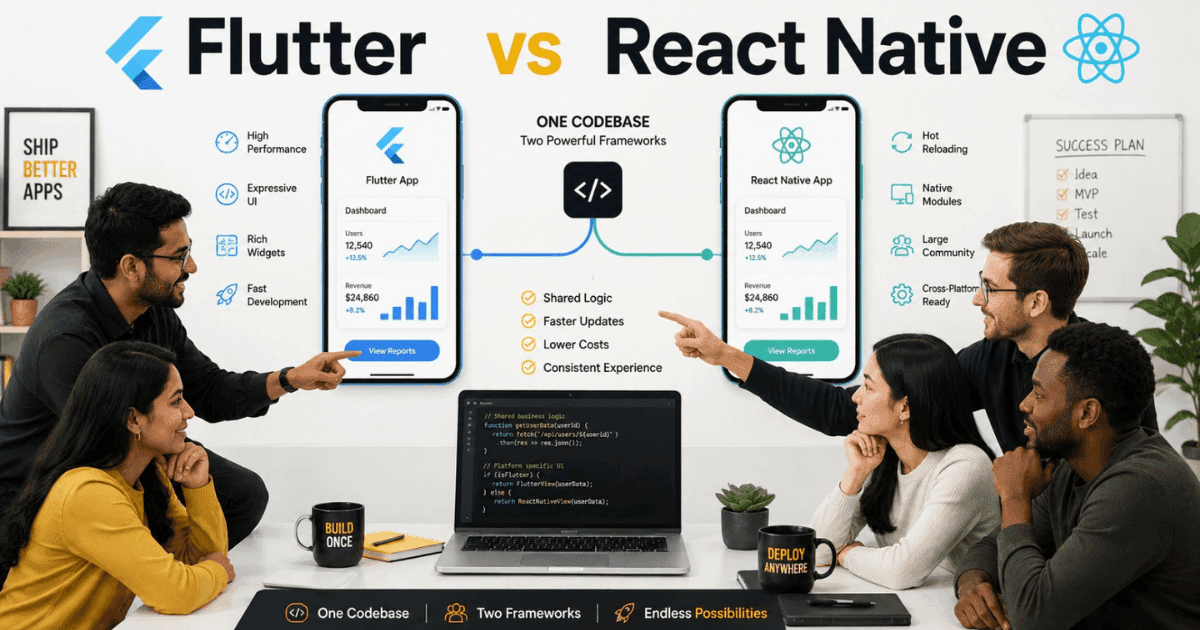
Pick the wrong framework and you don't find out for six months. Then the cracks show, the app feels off, hiring gets hard, and someone quietly says the word nobody wants to hear: rebuild.
So let's settle Flutter vs React Native properly. Not with fanboy noise. With the trade-offs that actually cost you money and time.
Both are cross-platform. That's the whole point of them. One codebase runs on iOS and Android, instead of paying two teams to build the same app twice. That alone can cut build cost and timeline meaningfully, which is why this choice matters to anyone spending real money.
In Stack Overflow's developer surveys, both frameworks have sat among the most-used cross-platform tools for years, trading places at the top. Neither is a fad. So the question isn't which is "better." It's which is right for your app. Let's break it down.
The 30-second version
If you want the answer before the detail, here it is.
React Native leans on JavaScript and the massive pool of developers who know it. Backed by Meta. Easiest when you already have web developers.
Flutter uses Dart, is backed by Google, and gives tight control over how every pixel looks. Great when design and smooth performance matter most.
Neither is wrong. The rest of this post is about matching one to your situation.
Cost: which one is cheaper to build?
This is the question most business owners really care about. And the honest answer is: the framework itself is rarely the deciding cost. Your team is.
Both save you money the same way, one codebase instead of two. That's the big saving, and it applies to both equally. Where the cost difference sneaks in is hiring and maintenance.
The hiring cost angle
React Native runs on JavaScript, the most common programming language on earth. That means a bigger pool of developers and, often, easier or cheaper hiring.
Flutter uses Dart. Fewer developers know it, though the number is growing fast. In some markets that means paying a little more or waiting a little longer to hire.
The build cost angle
For a straightforward app, build cost between the two is usually close. The difference is often a matter of which framework your chosen team already knows well.
A team fluent in one will build faster and cheaper in that one. Forcing a React Native team onto Flutter, or the reverse, costs you money. Match the framework to the team, or pick the team for the framework, but don't fight it.
Those are ballpark ranges for the Indian market, and they overlap on purpose. The framework rarely moves the number much. Your feature list, integrations, and team do. Treat the table as a reality check, not a quote.
Speed and performance
Both are fast enough for the vast majority of apps. If anyone tells you one is dramatically faster for a normal business app, be sceptical.
Flutter compiles to native code and renders its own UI, which gives very smooth, consistent performance, especially for animation-heavy or design-heavy apps. It controls every pixel itself.
React Native talks to the device's native components. Performance is smooth and close to native for most apps, and recent versions have narrowed the gap further on the heavy stuff.
For a typical app, booking, e-commerce, services, content, either handles it comfortably. Performance only becomes a deciding factor for graphically intense or animation-heavy products. Then Flutter's edge starts to matter.
Look and feel
Here's a real difference you can see. It comes down to how each draws the screen.
Flutter draws everything itself. That means your app looks identical on every phone, and you get pixel-perfect control over design. The trade-off is it may not automatically match each platform's native look unless you build for that.
React Native uses each platform's own components. So the app can feel more naturally "iOS on iPhone, Android on Android" out of the box. The trade-off is slightly less pixel-level control.
Neither is better. It depends whether you want one identical brand look everywhere, or a native feel on each platform.
Hiring and long-term maintenance
An app isn't a one-time build. You'll maintain it for years. So think past launch.
React Native's JavaScript base means a large, global talent pool. If your current or future developer leaves, replacing them is usually easier. That matters more than founders expect.
Flutter's Dart community is smaller but growing quickly and is known for being well-organised. You can absolutely hire for it. You just have a smaller pond to fish in, depending on your city.
The practical rule: whichever framework you can staff reliably for the next three years is the safer bet, regardless of which looks shinier today.
So, which should you choose?
Here's the honest verdict, no hedging.
Choose React Native if you already have web or JavaScript developers, want the easiest hiring, or want the app to feel native on each platform out of the box.
Choose Flutter if design and smooth animation are central to your product, you want one identical look across all devices, or you're building something visually rich.
For a large share of standard business apps, either will serve you well. The bigger risk is not the framework. It's a team that doesn't know the one they're using.
At Nipralo Technologies, we build in both, and we pick based on your app and your team, not on which we personally prefer. When one is clearly right for you, we'll say so and explain why in plain language. You can see the apps our team has shipped in our web and mobile app portfolio.
Flutter vs React Native isn't a war with one winner. It's a fit question. Match the framework to your app, your team, and your next three years, and either one can carry you a long way. You can read more on the official Flutter and React Native sites before you decide.
Still not sure which one fits your app?
Book a free 20-minute call. Tell us what you're building and who's on your team, and we will tell you honestly whether Flutter or React Native is the right call, and why. No pitch, no pressure.
Frequently Asked Questions
Is Flutter better than React Native?

Neither is universally better. Flutter gives tighter control over design and very smooth performance, which suits visually rich apps. React Native uses JavaScript and native components, making hiring easier and giving a native feel per platform. The right choice depends on your app and your team.
Should I use Flutter or React Native for my app?
Choose React Native if you already have web or JavaScript developers or want easy hiring and a native feel on each platform. Choose Flutter if design and smooth animation are central or you want one identical look across all devices. For most standard business apps, either works well.
Which is faster, Flutter or React Native?
Both are fast enough for the vast majority of apps. Flutter compiles to native code and renders its own UI, giving a slight edge on animation-heavy products. React Native performs close to native for most apps. Performance only becomes a deciding factor for graphically intense products.
Is Flutter or React Native cheaper to develop?
Build cost is usually close, because both use one codebase for iOS and Android. The real cost difference comes from hiring. React Native runs on JavaScript, so the talent pool is larger and often cheaper. Dart developers for Flutter are fewer, though the number is growing quickly.
Which is easier to learn, Flutter or React Native?
React Native is often easier to start with if you or your team already know JavaScript, since it is the most common programming language. Flutter uses Dart, which is straightforward but less widely known. If your team has a web background, React Native usually has the gentler learning curve.