
All Posts
Frontend vs Backend vs Full Stack: Which Developer Does Your Business Actually Need?
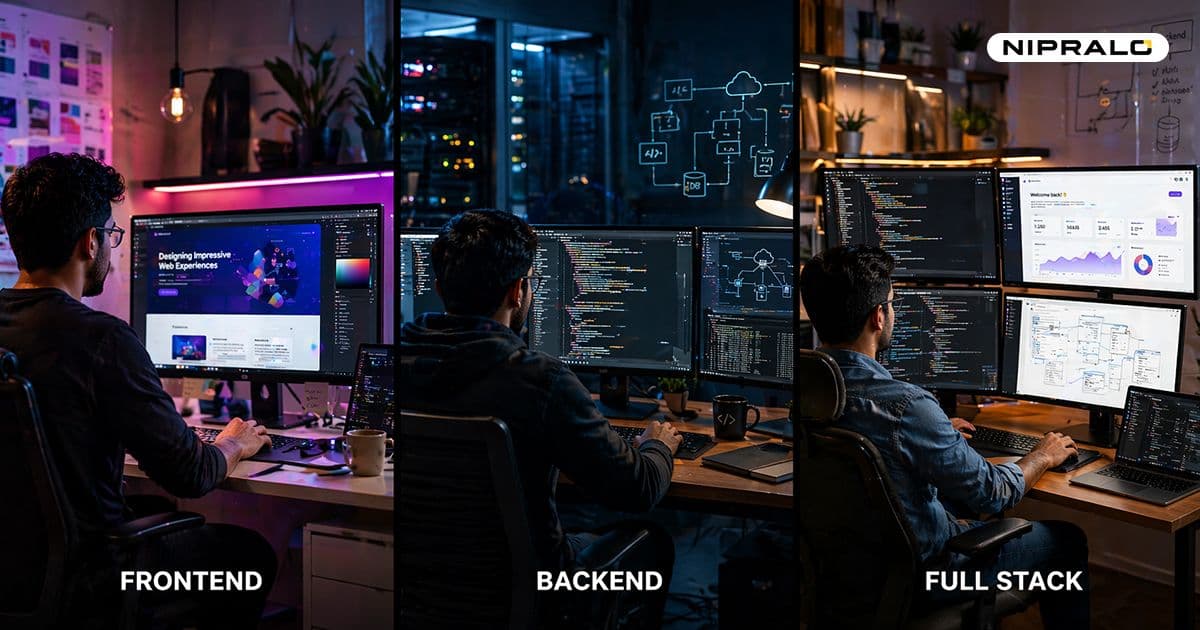
Most business owners come to us saying the same thing. "I need a developer." When we ask what kind, we get a pause. Then: "full stack, I think."
Full stack sounds safe. Covers everything. One hire. Done.
But it is not always right. And hiring the wrong type — or getting the scope wrong — can cost you months and a rebuild nobody planned for. The frontend vs backend vs full stack decision matters more than most people realise before they make it.
Here is what each role actually means in practice. And more importantly, which one your project needs.
What Frontend, Backend, and Full Stack Actually Mean
Three roles. Different jobs. Often confused.
Frontend: The visible layer
Frontend is everything a user sees and touches. The layout, the buttons, the forms, the animations. If you can click it, scroll it, or read it, a frontend developer built that.
Tools they use: React, Next.js, Vue, HTML, CSS, JavaScript.
Your website's design. Your app's checkout flow. The dashboard your team logs into every morning. That is frontend work.
Backend: The engine underneath
Backend is invisible to the user but powers everything. Logic, databases, servers, APIs. When a customer submits an order, the backend processes it, updates inventory, sends a confirmation email, and logs the transaction.
Tools they use: Node.js, Python, PHP, Java, PostgreSQL, MongoDB.
If frontend is the face, backend is the brain and nervous system.
Full Stack: The generalist
A full stack developer works on both sides. They can build the interface and write the backend logic that powers it. They are not two developers in one. They are a developer with broader, and often shallower, coverage across both layers.
This is the right option more often than people think. But not always.
The Full Stack Myth Business Owners Believe
Here is the part most people miss.
Full stack is not a fixed point. The Stack Overflow Developer Survey 2024 found that over 65% of developers call themselves full stack. But most lean heavier toward one side.
A developer who is 80% frontend can build your React app beautifully. Hand them a complex database architecture for an ERP system and you will run into trouble. A developer who is 80% backend may produce a system that works but looks and feels rough.
The title does not tell you enough. You need to know which side they actually live on. And whether that matches what you are building.
When to Hire a Frontend Specialist
Choose a dedicated frontend developer when:
- Your competitive edge is the design and user experience: a consumer app, a brand website, an interface your customers use daily
- You already have a working backend and need only the interface rebuilt or improved
- You are optimising conversion rates, running A/B tests, or redesigning a customer-facing flow
- Speed, animation, and pixel-perfect output matter for your brand
A restaurant group in Mumbai came to us with a functioning POS backend. The interface was causing daily errors for staff. We worked on the frontend only. Four weeks. Problem solved. The backend did not need touching.
Hiring a full stack developer for that project would have been wasteful. A frontend specialist solved it faster and cheaper.
When to Hire a Backend Specialist
Choose a backend developer when:
- You are building something data-heavy: ERP, inventory management, a booking engine, payment flows
- Security and compliance are critical — fintech, healthcare, legal, HR systems
- You need API integrations with third-party services: CRMs, shipping providers, payment gateways, accounting software
- Your existing backend is slow, breaking under load, or accumulating technical debt
The interface can wait. A backend that leaks data or crashes at 300 concurrent users can kill a product. Backend is where you do not cut corners.
When Full Stack Is the Right Call
Full stack makes the most sense when:
- You are building an MVP or early-stage product where speed and budget matter more than depth
- The scope is clear and bounded — no surprise integrations, no heavy data processing edge cases
- You need internal tools, dashboards, or admin panels that need to work, not wow
- You want one person with full context across the build — no handoff friction between frontend and backend teams
Industry data shows that 63% of tech companies have moved toward full stack hiring over separate specialists. For startups and SMBs, one full stack developer can often replace two specialist hires — cutting 30 to 40% off your development spend.
For a bootstrapped founder or a business building its first digital product, that is a meaningful number.
What Does It Actually Cost in India?
India has strong developer talent across all three types. Rates vary by experience, city, and tech stack.
Full stack engineers in India typically earn 25 to 40% more than standalone frontend or backend developers. But two specialist hires together cost significantly more than one full stack developer — so the right decision depends on what your project genuinely needs, not which option sounds safer.
A rough guide for 2025-26:
These are in-house salary ranges. If you are working with an agency rather than hiring directly, the cost structure shifts — you pay for scope and delivery, not headcount. You can see examples of what we have built across web and mobile to get a sense of project types and scale.
Three Questions to Ask Before You Hire
These work whether you are hiring directly or briefing an agency.
What is the last complete project you built? What did you personally handle?
This tells you their actual depth and what they own versus what they lean on others for.
Which side of the stack are you stronger on? Where would you bring in help?
An honest developer will tell you. A good one gives you a specific example. If someone says they are equally strong on both sides at every level, push back.
Have you worked on projects similar to mine in terms of scope and complexity?
Domain context matters. A developer who has only built marketing sites should not be handed a logistics management platform on day one.
If you are not technical enough to evaluate the answers, bring in someone who is — even for one 45-minute review call before you commit. It is worth it.
We Figure This Out Before Writing a Line of Code
At Nipralo, we scope the project first, then assign the right team structure. A brochure site gets a frontend-first approach. A custom ERP or mobile app gets backend depth with a clean interface layer on top. We do not apply the same structure to every project because no two projects need the same thing.
See our services page for an overview of what we build — from custom websites to ERP systems and mobile apps.
Or skip straight to the conversation.
Book a free 20-min call and we will tell you exactly what kind of team, scope, and timeline your project needs.
Frequently Asked Questions
What is the difference between frontend, backend, and full stack development?

Frontend covers everything a user sees and interacts with: layouts, buttons, and animations. Backend handles the logic, databases, servers, and APIs that power the product behind the scenes. Full stack covers both, though most full stack developers have stronger depth on one side than the other.
Which type of developer should I hire for my startup or small business?
For most early-stage startups and small businesses, a full stack developer is the most practical choice. They handle end-to-end development without requiring two separate hires, which saves cost and reduces handoff delays. If your product is heavily design-focused or involves complex data systems, a specialist may deliver better results.
Is a full stack developer better than hiring separate frontend and backend developers?
Not always. A full stack developer works well when your scope is clear, your budget is lean, and speed to market matters. For complex systems with heavy data logic, or products where design is the core differentiator, specialists deliver greater depth. The right answer depends on your project type, not a general preference for one approach over another.
How much does it cost to hire a full stack developer in India in 2026?
A mid-level full stack developer in India typically costs between 8 and 16 lakhs per annum, depending on experience, city, and tech stack. Full stack developers generally earn 25 to 40 percent more than standalone specialists, but replacing two specialist hires with one full stack developer can still reduce your total development cost significantly.
When does it make sense to hire a specialist instead of a full stack developer?
Hire a backend specialist when your project involves complex data systems, payment processing, security compliance, or heavy API integrations. Hire a frontend specialist when the interface is your product's core differentiator or when an existing backend is working fine and only the UI needs improvement. Specialists deliver greater depth but require more coordination when both sides need work at the same time.