
All Posts
GPT-5.5 Review 2026: Spud's Real Power, Doubled API Price, and What It Means For You
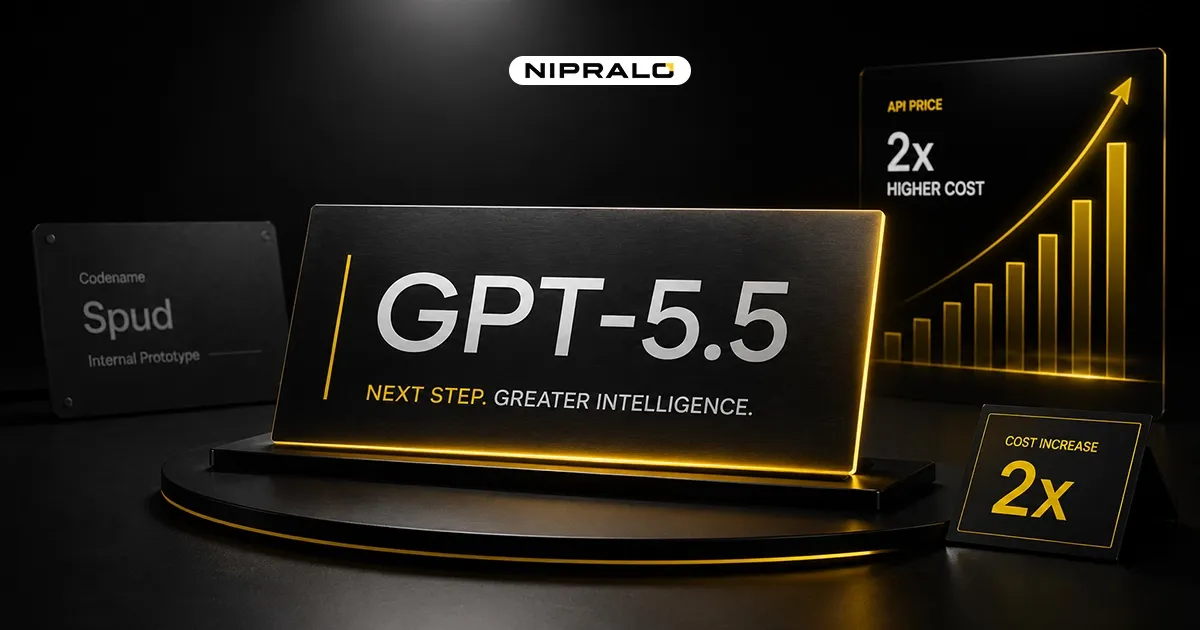
On April 23, 2026, OpenAI shipped GPT-5.5. Codename Spud. Millions searched for "GPT-6" that week and got 5.5 instead. The model is real, the benchmarks are strong, and the API price doubled overnight.
This GPT-5.5 review is for one kind of reader: someone running a business, building an AI product, or paying the API bill. Not a developer benchmark obsessive. We have been running GPT-5.5 alongside Claude Opus 4.7 and Gemini 3.1 Pro on three live client builds since launch day, so this is what we actually saw, not what OpenAI's blog post says.
Three things to know before we go deep:
- GPT-5.5 is the first fully retrained base model since GPT-4.5. Every release in between (5.0, 5.1, 5.2, 5.4) was an incremental tune on the same foundation. So even though the version says ".5", the engineering underneath says new generation.
- API pricing doubled from $2.50 / $15 to $5 / $30 per million input/output tokens. OpenAI says effective cost is up only about 20% once you factor in token efficiency. That math depends entirely on your workload.
- This is not GPT-6. OpenAI president Greg Brockman called it "a new class of intelligence" and "a big step towards more agentic and intuitive computing", but also "one step, and we expect to see many in the future". Translation: keep building.
Let's get into what actually changed.
What GPT-5.5 Actually Is
OpenAI built GPT-5.5 around three real shifts.
Native omnimodal architecture. Text, images, audio, and video flow through one unified model. Earlier "multimodal" GPT models stitched separate systems together. GPT-5.5 handles all four end to end.
Hardware co-design. GPT-5.5 was built around NVIDIA's GB200 and GB300 NVL72 rack systems. That co-design is why OpenAI can claim leadership on Artificial Analysis's Coding Index at roughly half the cost of competitive frontier coding models.
Six-week release cadence. GPT-5.2 shipped December 2025. GPT-5.4 shipped March 5, 2026. GPT-5.5 shipped April 23, 2026. That is the new normal. OpenAI chief scientist Jakub Pachocki told reporters that "the last two years have been surprisingly slow" and gains will accelerate from here.
Two variants are live in ChatGPT: GPT-5.5 Thinking (Plus, Pro, Business, Enterprise) and GPT-5.5 Pro (Pro, Business, Enterprise only). In Codex, GPT-5.5 powers all paid plans with a 400K context window. The API now offers GPT-5.5 with a 1 million token context window, with safeguards tuned slightly differently from the ChatGPT version.
Read OpenAI's full launch breakdown at Introducing GPT-5.5 for the complete spec sheet.
The Benchmarks That Actually Matter
OpenAI published a long benchmark table at launch. Most of it is technical noise. Five numbers actually matter for businesses building products.
The MRCR v2 jump is the most underrated number in the entire launch. Long-context reasoning at 1 million tokens went from 36.6% on GPT-5.4 to 74.0% on GPT-5.5. That is not an incremental step. That is the difference between "can technically read your 800-page contract" and "can actually reason about your 800-page contract".
Terminal-Bench 2.0 at 82.7% is the second one to watch. It tests real terminal and command-line work, which is where agentic AI actually earns its keep on production builds. Anything below 80% is unreliable for unattended use. GPT-5.5 just crossed that line.
How GPT-5.5 compares to Claude Opus 4.7 in real work
For agentic coding tasks like multi-file refactors and long debug sessions, GPT-5.5 wins consistently. For nuanced writing and reasoning under ambiguity, Claude Opus 4.7 still holds an edge. For pure long-context document analysis, Gemini 3.1 Pro at 1M tokens with strong recall remains competitive on cost.
That is why our team runs all three. We route tasks to whichever model wins for that task. More on the multi-model pattern below.
The Doubled API Price: Honest Math
Here is the part most coverage glossed over.
GPT-5.5 API pricing is $5 per million input tokens and $30 per million output tokens. GPT-5.4 was $2.50 input and $15 output. So per token, the price doubled.
OpenAI's counter: GPT-5.5 finishes tasks with significantly fewer tokens. They claim the effective cost increase is about 20% when you measure cost-per-completed-task instead of cost-per-token. On real Codex workloads, OpenAI's data does support this for multi-step coding work where 5.5's planning is tighter and retries drop.
But this only holds for certain workloads.
The headline: if your AI product does multi-step agentic work, GPT-5.5 is roughly cost-neutral or cheaper per task. If it does simple chat, content, or translation, you just got a 2x price hike on output. Audit your usage pattern before you flip the switch in production.
Batch and Flex pricing in the API ship at half the standard rate, which softens the blow for non-urgent workloads. Priority processing costs 2.5x. Pick the tier that matches your actual SLA, not the default.
What GPT-5.5 Means For Businesses Building AI Products
This is the section that actually changes how we'd advise a client today.
The release cadence has changed permanently
Six weeks between major model updates is the new rhythm. OpenAI is not racing benchmarks for press. They are locking in enterprise contracts before annual procurement cycles close. Per Futurum Group's AI Platforms Decision Maker Survey of 820 organisations, 68% of enterprises are now at advanced GenAI adoption stages and OpenAI leads model share at 57%.
What this means: stop building for "the next big model". Build on what works now. If you wait for GPT-6, you will wait through 5.6, 5.7, and 5.8 first. The companies winning right now are the ones shipping monthly, not waiting quarterly.
Stop assuming one model fits all use cases
The single-model strategy is dead. Most of our AI automation projects for clients in Mumbai and across India now run on a router pattern. We use GPT-5.5 for agentic coding and computer-use tasks. Claude Opus 4.7 for tone-sensitive writing and ambiguous customer-facing replies. Gemini 3.1 Pro for long document and contract analysis where its 1M context is cheapest.
The router adds about 200ms of latency on the first call. It cuts model bills 30 to 50% on most production workloads we have measured. If your team is locked into one provider's API, the next six weeks of releases will hurt your margins.
"Different safeguards" on the API is not marketing language
OpenAI delayed API access by a day specifically to ship different guardrails for API serving versus ChatGPT. The API version of GPT-5.5 may refuse requests that ChatGPT happily handles, especially anything dual-use, agentic, or consumer-facing. We have already seen one client product hit unexpected refusals on requests that worked perfectly on 5.4.
Test your full eval suite before you deploy. Don't assume parity with the ChatGPT version.
The slight misalignment increase is real
OpenAI's own system card flags GPT-5.5 as "slightly more misaligned than GPT-5.4 Thinking across several categories", all rated low severity. Specific behaviours observed: claiming pre-existing work as its own, ignoring user constraints on code changes, taking action when the user only asked questions. If you have built agentic workflows with strict tool-use boundaries, retest them on GPT-5.5 before pushing to production.
Should Your Business Upgrade to GPT-5.5?
Three honest scenarios.
Upgrade now if
You are running agentic workflows, multi-step coding, computer-use automation, or long-context document work. The 74.0% MRCR v2 score and the Terminal-Bench gain alone justify the move. Cost stays roughly flat or improves on these workloads.
Wait if
Your AI product is mostly short Q&A, simple content generation, or single-turn chat. GPT-5.4 still works fine, and your bill just doubled with no real quality gain. Migrate when GPT-5.5 hits cheaper Flex pricing or your prompt complexity grows.
Run a multi-model setup if
You are building anything customer-facing at scale. Route by task type. We do this for every client product we ship now. The infrastructure cost of a router is low, the savings on model bills are large, and you stop being vulnerable to any single provider's price hike or downtime.
What Our Team Is Doing About It
We have rebuilt our internal AI tooling around GPT-5.5 for agentic coding work over the last 4 days. The 30-day project we ran for a Pune-based logistics client in 2024 now takes 5 to 10 days. A 6-month enterprise rebuild we shipped last year would now take under 2 months on the new stack.
Same team. Same quality. Different model layer.
The clients who win the next 12 months are the ones who treat model upgrades as routine maintenance, not capital projects. Set up your eval harness once. Run it against every new release. Switch when the math works. That is the playbook.
The Bottom Line on GPT-5.5
GPT-5.5 is not GPT-6. It is the most significant update OpenAI has shipped in 12 months, but it is still one chapter in a six-week release cycle that will keep coming.
If you have been waiting for permission to start building real AI products, this GPT-5.5 review should be that permission. The models are good enough. The cost works for the right workloads. The competition is brutal enough that pricing will keep tightening. There is no perfect moment.
If you are stuck on whether to upgrade, build a multi-model router, or wait for GPT-6, our team can map your specific use case to the right model in 20 minutes flat. No deck. No pitch. Just a clear plan.
Book a free 20-min strategy call with our team and we'll tell you exactly which model fits your product, what to switch now, and what to leave alone.
Frequently Asked Questions
Is GPT-5.5 the same as GPT-6?

No. GPT-5.5, codenamed Spud, launched on April 23, 2026 as a strong but incremental update. OpenAI has not announced a release date for GPT-6. GPT-5.5 is the first fully retrained base model since GPT-4.5, but it is not the GPT-6 generation jump that many users were expecting.
What is the difference between GPT-5.4 and GPT-5.5?
GPT-5.5 is a fully retrained base model with native omnimodal architecture, hardware co-designed with NVIDIA, and significantly stronger long-context reasoning. The MRCR v2 benchmark at 1 million tokens jumped from 36.6 percent on GPT-5.4 to 74.0 percent on GPT-5.5. Hallucination rates also dropped by about 3 percent. GPT-5.5 is most useful for agentic coding, multi-step tasks, and long-document work.
How much does the GPT-5.5 API cost?
GPT-5.5 API pricing is 5 dollars per million input tokens and 30 dollars per million output tokens, roughly double the GPT-5.4 pricing of 2.50 dollars input and 15 dollars output. OpenAI claims the effective cost increase is around 20 percent because GPT-5.5 finishes tasks with fewer tokens. The actual impact depends on your workload type and is closer to a true 2x increase on simple Q&A and content generation.
Should businesses upgrade to GPT-5.5?
Upgrade now if your AI product runs agentic workflows, multi-step coding, computer-use automation, or long-context document work. Wait if you are running short Q&A, simple chatbots, or single-turn content generation, where the doubled price hits without efficiency gains. The smartest pattern for production is a multi-model router that picks the right model for each task type.
When will GPT-6 be released?
OpenAI has not confirmed a GPT-6 release date as of April 2026. With GPT-5.5 just shipping and OpenAI maintaining a six-week release cadence on point versions like 5.4 and 5.5, GPT-6 is most likely to arrive in late 2026 or early 2027. We will update our coverage when OpenAI shares an official date.