
All Posts
GPT-5.6 Sol vs Terra vs Luna: Every Tier, Price, and Benchmark Ranked for Business (July 2026)
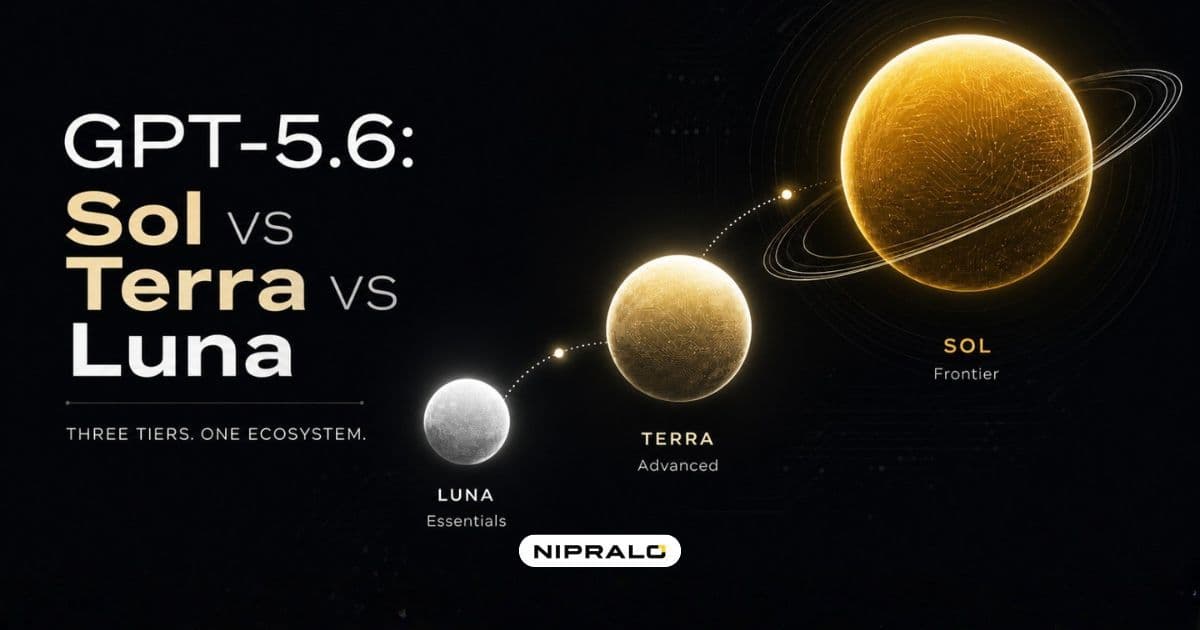
OpenAI shipped GPT-5.6 on July 9, 2026. Not one model. Three: Sol, Terra, and Luna. And the price gap between the cheapest and the most expensive tier is 5x.
That gap is the whole story. Pick wrong and you either overpay every single month or ship a product that feels dumb next to your competitor's. The GPT-5.6 Sol vs Terra vs Luna decision is a budget decision dressed up as a tech decision, and most of the coverage so far reviews the models instead of helping you choose.
We build AI features into client software for a living. This post is the tier-picker we wish existed on launch day.
What GPT-5.6 actually is
GPT-5.6 is OpenAI's new flagship family, and it changes the naming system. The number is the generation. The name is the tier. Sol, Terra, and Luna are permanent capability lanes that will carry forward into future generations, so learning what each lane means pays off beyond this release.
Here's the one-line version of each:
- Sol is the flagship. Highest ceiling, best at long multi-step work, most expensive.
- Terra is the everyday model. Roughly matches the previous flagship GPT-5.5 at about half the cost.
- Luna is the speed-and-volume model. Cheapest, fastest, built for high-frequency simple tasks.
All three are live in the API right now. In regular ChatGPT, only Sol shows up in the model picker on paid plans. Terra and Luna are API, Codex, and ChatGPT Work options. So if you're deciding what to build your product or internal automation on, the API pricing below is the number that matters.
Sol: pay for it when the task is genuinely hard
Sol is the tier OpenAI leads every benchmark chart with. On the Artificial Analysis Coding Agent Index, an independent test of real coding-agent work, Sol set a new high of 80, edging past Claude Fable 5 by 2.8 points. On Agents' Last Exam, which tests long professional workflows across 55 fields, Sol scored 53.6, the highest result recorded.
Translation for a business owner: Sol is the model you want when the job has many steps, spans hours, and failure costs you money. Think an agent that reads your entire order history, reconciles it against invoices, flags mismatches, and drafts the emails. Or a coding agent rebuilding a legacy module across dozens of files.
But Sol is not automatically the best at everything. On SWE-Bench Pro, a hard software engineering test, Sol scored 64.6% while Claude's top models scored around 80%. No single model wins every category in July 2026. Anyone telling you otherwise is selling something.
And Sol's real risk isn't capability. It's the bill. At $30 per million output tokens, a chatty agent that runs all day gets expensive quietly. We've seen this pattern with clients before: the pilot costs ₹8,000 a month, the rollout costs ₹80,000, and nobody checked the routing.
Terra: the default your business probably needs
Terra is the tier most businesses should start with. OpenAI positions it as competitive with GPT-5.5, which was the flagship model until last week, at roughly half the price. Read that again. The thing that was state of the art in June now costs $2.50/$15 per million tokens.
For the work most SMBs actually automate, Terra is enough:
- Customer support drafts and replies
- Proposal and quote generation
- First-pass document review
- Internal report summaries
- CRM data cleanup and enrichment
One honest caveat. The tier ordering isn't perfect. On Terminal-Bench, a command-line agent test, Luna actually scored above Terra. Benchmarks are messy like that. But across the broad intelligence tests, Terra sits clearly between Sol and Luna, which is exactly where its price sits.
Luna: the volume workhorse
Luna costs $1 in and $6 out per million tokens. That's cheap enough to change what's worth automating at all.
Tasks that were "not worth the API bill" at flagship prices become obvious at Luna prices. Tagging every incoming support ticket. Extracting fields from every invoice. Summarizing every sales call. Scoring every lead. If the task is short, well-defined, and happens hundreds of times a day, Luna is your tier.
Where Luna breaks: long context. On OpenAI's own MRCR long-document test, Luna dropped to around 41% once documents passed 256K tokens. So don't hand Luna your 300-page contract and expect miracles. Route long-document work up to Terra or Sol.
The smart pattern: don't pick one tier
Here's what the launch coverage mostly misses. The three-tier structure exists so you can route work, not marry a model. CodeRabbit's engineering review landed on the same pattern we use in client builds: Luna handles the first pass, Terra handles the scoped work, and Sol gets called only when the task earns it.
A Mumbai logistics client of ours runs exactly this shape on a previous model generation. Document intake on the cheap tier, exception handling on the mid tier, and the expensive model touches maybe 4% of jobs. Their AI bill is about a third of what a single-model setup would cost. GPT-5.6 makes this pattern easier because all three tiers share one generation and one API.
About that math proof everyone is sharing
The viral moment: on July 10, OpenAI announced that Sol Ultra, the multi-agent mode running 64 subagents in parallel, produced a proof of the Cycle Double Cover Conjecture in under an hour. The problem had been open in graph theory for roughly 50 years.
Two things are true at once. It's genuinely impressive, and it's not yet peer reviewed. Coverage from The Decoder notes mathematician Thomas Bloom called it a very nice, surprisingly elementary proof while flagging missing citations to prior work. The graph theory community is still checking it.
What it means for your business is simpler than the headlines. Ultra mode, the thing behind the proof, is available in the API today. Parallel subagents attacking one hard problem used to be a research-lab trick. Now it's a line item. You will not use it for support tickets. You might use it for the one gnarly optimization problem that actually moves your margin.
Three cost traps to avoid
Output tokens are where the money goes. Every tier charges 5-6x more for output than input. A verbose system prompt that makes the model write long answers costs you at every single call. Trim it.
Cache writes now cost extra. GPT-5.6 bills cache writes at 1.25x the input rate, while cache reads keep a 90% discount with a 30-minute minimum cache life. For agents that reread the same documents, caching done right is a massive saving. Done wrong, it's a surcharge.
ChatGPT is not the API. Your team testing prompts in ChatGPT is using Sol. If your product then runs on Luna to save money, the quality gap will surprise you. Test on the tier you'll ship on.
How to pick your tier in four steps
- List your actual tasks. Not "use AI", but the specific jobs: reply to tickets, extract invoice fields, review pull requests.
- Sort by volume and difficulty. High volume plus simple goes to Luna. Moderate difficulty goes to Terra. Long, hard, multi-step goes to Sol.
- Run a two-week test on real data. Pick your 20 most common inputs, run them through the tier you sorted them into, and have the person who does the job today grade the outputs.
- Add routing before you scale. Even a simple rule, like "escalate to Sol when Terra's confidence is low", keeps the bill sane as usage grows.
That test costs a few hundred rupees in API credits. Skipping it costs you either quality or 5x your necessary spend, every month, forever.
Our verdict on GPT-5.6 Sol vs Terra vs Luna
Start on Terra. It's the previous flagship's quality at half the price, and it covers most of what an SMB automates. Route your high-volume simple tasks down to Luna and watch the bill drop. Reserve Sol for the genuinely hard agent work, and treat Sol Ultra as a specialist tool, not a default.
And expect this decision to stick around. Sol, Terra, and Luna are permanent tiers now. The routing you set up this month keeps working when GPT-5.7 lands in the same lanes.
If you'd rather not run the evaluation yourself, this is exactly the work our team does when we build AI into client software: pick the tier, wire the routing, and connect it to your actual workflows, whether that's a custom web app, an ERP, or something we build from scratch like our web and app work. The model is a commodity. The integration is where it pays off or doesn't.
Book a free 20-min call and we'll tell you which tier fits your workload, even if you build it without us.
Not sure which GPT-5.6 tier fits your business?
Book a free 20-minute call. We'll map your actual workflows to Sol, Terra, or Luna and show you what a custom integration would cost.
Frequently Asked Questions
What is the difference between GPT-5.6 Sol, Terra, and Luna?

They are three capability tiers of the same model generation. Sol is the flagship with the highest reasoning ceiling, Terra is the balanced everyday model roughly matching the older GPT-5.5, and Luna is the fastest and cheapest option. The number is the generation and the name is the tier, so these lanes will continue in future releases.
How much does GPT-5.6 cost per million tokens?
Sol costs 5 dollars for input and 30 dollars for output per million tokens. Terra costs 2.50 dollars input and 15 dollars output. Luna costs 1 dollar input and 6 dollars output. Cache reads get a 90 percent discount, while cache writes are billed at 1.25 times the input rate.
Is GPT-5.6 Terra as good as GPT-5.5?
OpenAI positions Terra as competitive with GPT-5.5 at about half the cost, and independent testing broadly supports that for everyday tasks. It slips below GPT-5.5 on a few specific benchmarks like Terminal-Bench. For most business automation like drafts, reviews, and summaries, Terra delivers flagship-grade quality from just weeks ago at a much lower price.
Which GPT-5.6 model is best for business automation?
Most businesses should start with Terra as the default and route high-volume simple tasks like tagging, extraction, and scoring down to Luna. Reserve Sol for long multi-step agent work and complex coding where quality justifies the cost. A routed setup across tiers typically costs a fraction of running everything on Sol.
Did GPT-5.6 really solve a 50-year-old math problem?
OpenAI announced that Sol Ultra, running 64 parallel subagents, produced a proof of the Cycle Double Cover Conjecture in under an hour. Mathematicians have called the proof elegant, but it has not yet passed peer review and the conjecture has attracted flawed proofs before. Treat it as a strong signal of multi-agent capability rather than a settled fact.