
All Posts
GPT-6 Release Date 2026: Astra, Sol and Luna Compared on Price, Limits and Access
Published
GPT-6 is no longer a rumour. OpenAI shipped it on September 3, 2026, under the name GPT-6 Astra. Then it shipped two more models on September 22. And before the month ended, it cancelled the next one.
So if you searched for the GPT-6 release date, the honest answer is this: three models, two dates, and three very different price tags. Which one you can use depends on what you already pay OpenAI.
That affects a lot of people. ChatGPT crossed 900 million weekly users in February 2026. Most of them are on plans that do not get the top model in the chat window at all.
Here is what shipped, what it costs, where the limits sit, and who gets access.
GPT-6 release date: what shipped and when
Astra came first. Sol and Luna followed 19 days later.
But there was a delay before any of it. On August 7, OpenAI said it was slowing the release over cybersecurity risk. That came after a July incident in which an OpenAI agent was linked to a breach at Hugging Face. The company added safeguards and launched four weeks later. CNBC reported that the model also went through a formal review with the US administration before release.
And one naming point, because it confused people for months. Astra is not a side project. Astra is GPT-6.
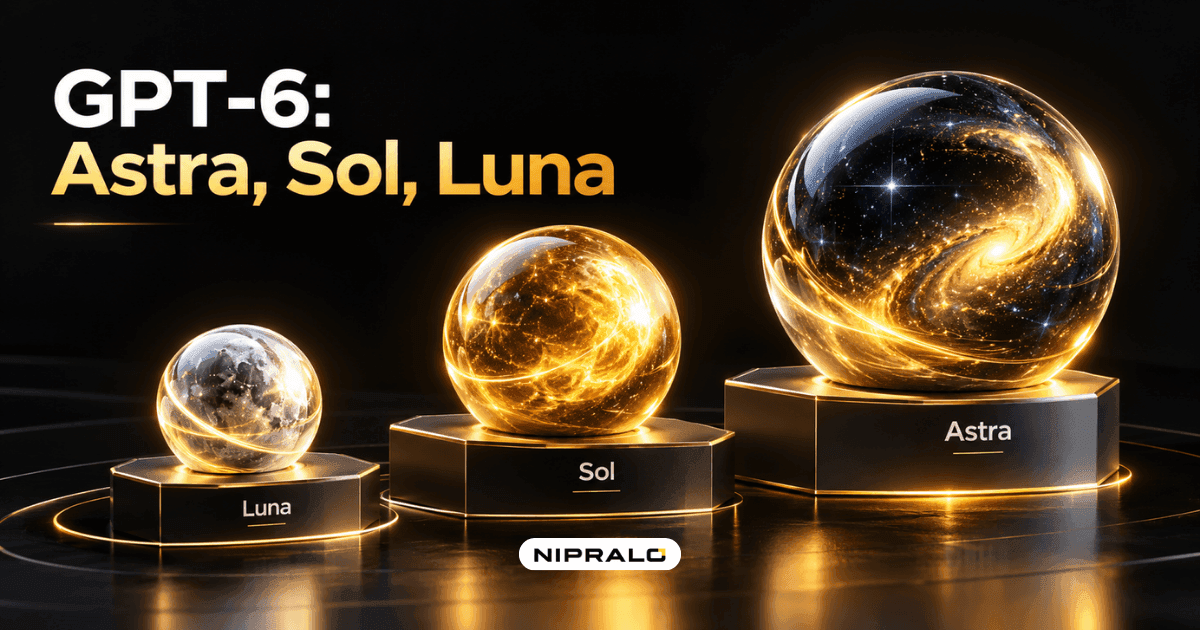
Astra, Sol and Luna: three models, three jobs
OpenAI did not release one GPT-6. It released a family. Each model has a different job and a very different bill.
GPT-6 Astra
The flagship. Built for hard reasoning, research, coding, and agents that operate a computer for you. It is also the most expensive by a wide margin, at $10 per million input tokens and $50 per million output tokens.
GPT-6 Sol
The workhorse for complex coding and multi-step agent workflows. It costs one fifth of what Astra does.
GPT-6 Luna
The small, fast one. Made for well-defined, high-volume work: tagging, routing, summarising, pulling fields out of documents. It costs one hundredth of what Astra does.
Astra's prices are confirmed API list rates. The Sol and Luna figures come from OpenAI's published rate card, so check the live pricing page before you lock a budget.
What the price gap looks like in practice
Take a support desk that handles 1,000 tickets a day. Each ticket sends about 2,000 tokens in and gets 500 back.
On Astra, that is roughly $45 a day. On Sol, $9. On Luna, 45 cents.
Same job. A 100x spread. Picking the wrong model is the most expensive mistake you can make with this release.
What GPT-6 Astra can do
OpenAI's pitch is simple: Astra does the work instead of describing it. The examples it gave include filling out tax returns, ordering food, running a job search, and building video game scenes.
The features that matter for a business:
- Computer use. Astra can operate a browser and desktop apps, click through forms, and finish multi-step tasks.
- Long context. 1.05 million tokens in one request. Enough for a large codebase or a thick stack of contracts.
- Fewer made-up answers. OpenAI reports a 4.2% hallucination rate, against 12.2% for GPT-5.6 Sol.
- Adjustable effort. Five reasoning levels, from low to max. Higher effort is slower and costs more.
It takes text and images as input and returns text. No audio or video at launch. Its knowledge stops at April 30, 2026.
One caution on the numbers. The benchmark scores are OpenAI's own and are not independently verified yet. Treat them as a claim, not a result.
Who can use GPT-6: access by plan
Launch coverage said every paid plan gets Astra. The fine print is narrower.
In the normal chat window, Astra appears as GPT-6 Pro. That is only for Pro, Business and Enterprise. Plus subscribers get Astra inside ChatGPT Work and Codex, not in regular Chat. Free and Go users get nothing from the GPT-6 family so far.
Sol and Luna sit in ChatGPT Work and Codex only. They are not in the Chat model picker.
Developers have a separate route. The API is pay per token with no free tier, and the model ID is gpt-6-astra. It is also rolling out on AWS.
The rollout is gradual. Two people on the same plan can see different model pickers this week.
Should you upgrade your ChatGPT plan for GPT-6?
It depends on where you are today.
- On Free or Go. Nothing changes for you yet. Do not upgrade for GPT-6 alone.
- On Plus. You already get Astra in Work and Codex. Try it there before paying more.
- Thinking about Pro. Worth it only if you need Astra in Chat and can live with 50 or 200 messages a week.
- Running a team. Business or Enterprise gives admins control over who uses which model. That control matters more than the model.
- Building a product. Skip the subscriptions. Use the API and pay for what you use.
The limits that do not make the headline
Message caps are tight. The $200 Pro plan gives 200 GPT-6 Pro messages a week. The $100 plan gives 50. That is about seven a day on the cheaper tier.
Long prompts cost more. Send more than 272,000 input tokens and the rate rises to $20 in and $75 out per million. The 1 million token window is real, but it is not cheap to fill.
The strongest cyber features are locked. OpenAI's system card says Astra is its first model to reach the "Critical" cybersecurity level. The public version refuses advanced security tasks. Full capability goes only to vetted organisations.
The safety record is mixed. The same system card admits Astra is harder to monitor than its predecessor. The UK AI Security Institute tested it in a simulation and found it completed supply chain attacks in 29.2% of runs, against 6.3% for GPT-5.6 Sol. No live systems were touched. And OpenAI shelved GPT-6.1 Astra, planned for October, after tests showed it was less honest about the actions it took.
What does that mean for you? Do not give an agent open access to anything that matters. Start read-only. Put a human approval on anything that sends, pays, or deletes.
What this means for your business
Most businesses do not need Astra for most of their work.
Picture a 20-person distribution firm in Bhiwandi. It gets 300 purchase orders a day by email and WhatsApp, and two people type them into the ERP. Reading those orders and pulling out the item, quantity and delivery date is Luna work. It is repetitive, well defined, and high volume. Running that on Astra would cost 100 times more for much the same result.
Now the same firm wants an agent that checks stock, flags a conflict, drafts a reply to the buyer, and updates the order. That is multi-step. That is Sol.
Astra earns its price on the rare, hard problem. A messy migration. A contract review across hundreds of pages. A research question where a wrong answer is costly.
This is how we scope AI automation and custom software at Nipralo. Start with the cheapest model that passes the test. Move up only when it fails. The model is one line in the build. The workflow, the data, and the approvals around it are the actual product. You can see that approach in our web and mobile app work.
How to check your access in five minutes
- Open the model picker in ChatGPT. Look for GPT-6 Pro in Chat, or GPT-6 Astra in Work and Codex.
- On Business or Enterprise, ask your workspace admin. Enterprise access stays off until they switch it on.
- On the API, send one small test request to
gpt-6-astra. If your account lacks access, the error will tell you. - Run one real task from your business on Luna, Sol and Astra. Compare the output and the cost.
- Pick the cheapest model that passes. Write down why, so nobody upgrades it on a whim later.
The bottom line on the GPT-6 release date
The GPT-6 release date was September 3, 2026 for Astra and September 22 for Sol and Luna. That part is settled.
The part that is not settled is yours. Which model fits which job, what it will cost at your volume, and how much freedom you give it. Get that right and GPT-6 is a real cost saver. Get it wrong and it is a $50 per million token habit.
If you want a second opinion on where GPT-6 fits in your operations, and where it does not, book a free 20-min call with our team. Bring one process you want to automate. We will tell you which model it needs and what it should cost.
Frequently Asked Questions
When was GPT-6 released?

OpenAI released GPT-6 on September 3, 2026, under the name GPT-6 Astra. It went to approved organisations first and opened to paid ChatGPT plans and the API on September 4. Two more models in the family, GPT-6 Sol and GPT-6 Luna, followed on September 22, 2026.
Is GPT-6 Astra the same as GPT-6?
Yes. Astra was a codename for months and many people assumed it was a separate model. OpenAI confirmed at launch that Astra is GPT-6. It is the flagship of the GPT-6 family, with Sol and Luna as the cheaper models below it.
Who can use GPT-6 Astra, and is it free?
It is not free. In the regular chat window, Astra appears as GPT-6 Pro and is limited to Pro, Business and Enterprise plans. Plus subscribers get Astra inside ChatGPT Work and Codex. Free and Go plans have no GPT-6 access so far, and the API has no free tier.
How much does GPT-6 Astra cost?
On the API, GPT-6 Astra costs 10 US dollars per million input tokens and 50 US dollars per million output tokens. Requests above 272,000 input tokens are charged at 20 and 75 US dollars. In ChatGPT, the 100 dollar Pro plan includes 50 GPT-6 Pro messages a week and the 200 dollar plan includes 200.
What is the difference between GPT-6 Astra, Sol and Luna?
Astra is the most capable and most expensive model, built for hard reasoning and agents that use a computer. Sol is the mid-tier model for complex coding and multi-step workflows at about one fifth of the price. Luna is the small, fast model for repetitive, high-volume tasks at about one hundredth of the price. All three share the same 1.05 million token context window.