
All Posts
How to Build an MVP 2026: Every Step, Cost, and Mistake Explained
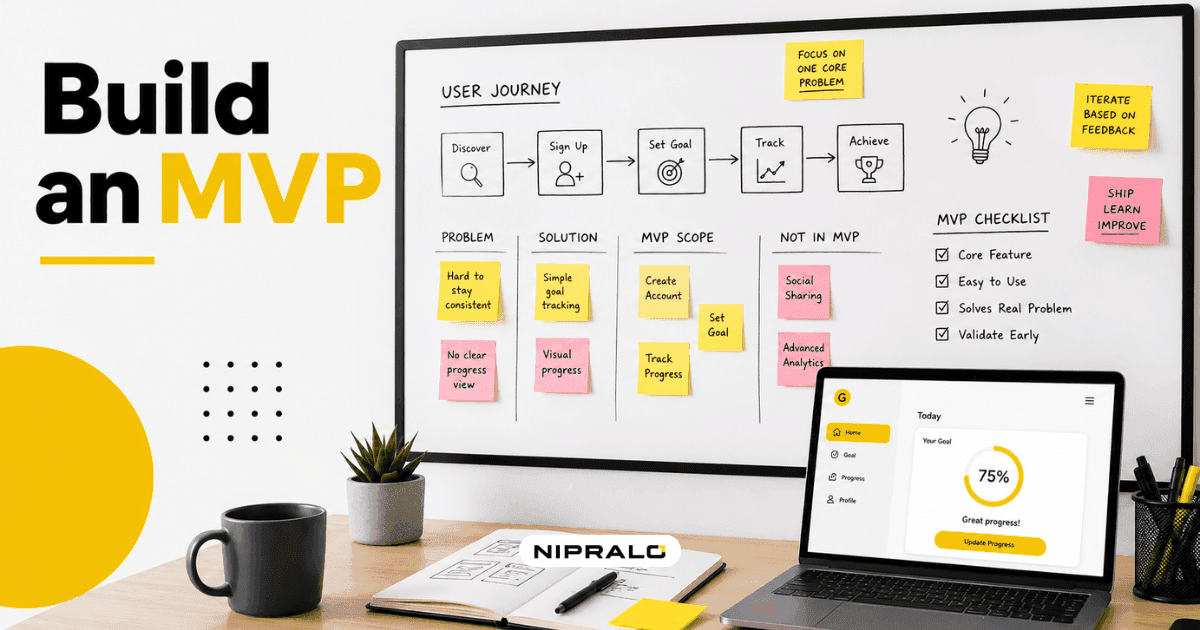
Most startups don't die because the idea was bad. They die because they built the wrong thing, spent the whole budget doing it, and ran out of runway before anyone told them it wasn't needed.
The numbers back this up. CB Insights' analysis of why startups fail put "no market need" at the very top of the list, with running out of cash close behind. An MVP fights both at once.
A minimum viable product is the smallest version of your idea that a real customer can use and pay for. Not a demo. Not a slide. A working thing that proves people actually want it.
This guide walks you through how to build an MVP in 2026, step by step. The real stages, the honest costs, and the mistakes that quietly sink first-time founders. No jargon, no fluff.
First, what an MVP is NOT
Let's clear this up before we start, because half the mistakes come from getting it wrong here.
An MVP is not a cheap, broken version of your full product. It's a complete experience of one core thing, done well. Small in scope, not small in quality.
It's also not a prototype. A prototype shows how something might work. An MVP is the real thing in a customer's hands, doing one job properly.
How to build an MVP: the 7 steps
Here's the full sequence. Work through it in order. Skipping steps early is exactly how founders end up building the wrong thing fast.
Step 1: Define the one problem you're solving
Not five problems. One. Write it in a single sentence a stranger could understand.
If you can't name the specific pain your product removes, you're not ready to build. You're ready to keep talking to customers. The clearer the problem, the smaller and cheaper the MVP.
Step 2: Find your one core feature
Your idea probably has twenty features in your head. Your MVP has one. The single feature that solves the problem from Step 1.
Everything else is a distraction for now. Ask yourself: if the product did only this one thing, would someone still use it? That one thing is your MVP.
Step 3: Map the user journey
Walk through exactly what a user does, from opening your product to getting the result they came for. Keep it to the shortest path possible.
Every extra screen, click, or signup field is a place people drop off. A tight journey is a cheaper build and a better product. Both at once.
Step 4: Choose how to build it
You have three real options here, and the right one depends on your budget, your timeline, and how unique your idea is. No-code tools, a freelancer, or an agency.
We'll break the cost of each down in a moment. The key is to match the build method to the stage you're at, not to your ego about how "real" the product feels.
Step 5: Build only the core, ruthlessly
This is where discipline pays off. Build the one feature, the short journey, nothing else. When you're tempted to add "just one more thing," don't.
Every feature you add before launch is a bet with no data behind it. Save those bets for after real users tell you what they actually want.
Those are ballpark ranges for the Indian market. A simple no-code MVP can cost almost nothing to test an idea. A custom-built one climbs with complexity. Pick the cheapest method that can genuinely prove your idea.
Step 6: Launch to real users, fast
Get it in front of actual people who have the problem. Not friends and family who'll be polite. Real potential customers who'll be honest with their wallets.
The goal isn't a big launch. It's a real one. Ten users who actually use it teach you more than a thousand who signed up and vanished.
Step 7: Measure, learn, and decide
Now the real work starts. Watch what people do, not what they say. Do they come back? Do they pay? Do they tell others?
This is the build-measure-learn loop that Eric Ries made famous in The Lean Startup. You build the smallest thing, measure how real users respond, learn from it, then decide what to build next. Repeat.
The mistakes that sink MVPs
Knowing the steps isn't enough. Here are the traps that catch first-time founders, even smart ones.
Building too much before launch
The number one killer. Founders fall in love with features and delay launch for months. Meanwhile the budget drains and no one has confirmed the idea works.
Ship the one core thing. Everything else waits for data.
Chasing perfect instead of real
Your MVP will have rough edges. That's fine. Early users forgive rough if the core solves their problem. They don't forgive a product that never ships.
Ignoring what users actually do
Founders love feedback that agrees with them. The useful signal is behaviour. If people say they love it but never come back, believe the behaviour, not the compliment.
Picking the wrong build method
Spending ₹8 lakh on an agency to test an idea a ₹30,000 no-code build could have validated is a classic. And so is trying to build a complex, regulated product entirely on no-code. Match the method to the stage.
How long should all this take?
For most small startups, a focused MVP takes anywhere from a couple of weeks on no-code to three months for a custom build. If your plan runs longer than that before a single real user touches it, your scope is too big.
The point of speed isn't to rush quality. It's to reach the moment of truth, real users reacting to a real product, before you've spent everything getting there.
The one thing to remember
How to build an MVP comes down to a single discipline: build the smallest real thing that answers one question, is this worth it.
Everything in this guide serves that. Define one problem. Build one feature. Launch fast. Learn from behaviour. Then, and only then, build more.
At Nipralo Technologies, we've watched founders succeed by shipping small and fail by building big in silence. So when a founder comes to us with a fifty-feature plan, our first job is often to talk them down to five. You can see the kind of products our team has helped build in our web and mobile app portfolio.
Build small. Launch real. Learn fast. That's the whole game, in 2026 and well beyond.
Got an idea but not sure how small to start?
Book a free 20-minute call. Tell us your idea and we will help you cut it down to the one MVP worth building first, and tell you honestly what it should cost and how long it should take. No pitch, no pressure.
Frequently Asked Questions
What is an MVP in a startup?

An MVP, or minimum viable product, is the smallest working version of your idea that a real customer can use and pay for. It solves one core problem well rather than doing many things poorly. Its job is to test whether people actually want your product before you spend the full budget building it.
How do I build an MVP step by step?
Define the one problem you solve, pick the single core feature that solves it, and map the shortest user journey. Then choose a build method, build only the core, launch to real users fast, and measure their behaviour. Use what you learn to decide what to build next.
How much does it cost to build an MVP?
In India, a no-code MVP can cost from nothing to around ₹50,000, a freelancer build often runs ₹50,000 to ₹3 lakh, and an agency build starts around ₹3 lakh and climbs with complexity. Pick the cheapest method that can genuinely prove your idea works.
How long does it take to build an MVP?
A simple no-code MVP can take one to three weeks, a freelancer build three to eight weeks, and an agency build six to twelve weeks. If your plan runs longer than about three months before any real user touches it, your scope is almost certainly too big.
What is the difference between an MVP and a prototype?
A prototype shows how something might work and is often thrown away. An MVP is the real product in a customer's hands, doing one job properly, and it can take real money. A prototype tests an idea internally, while an MVP tests actual demand in the market.