
All Posts
How to Use AI in Your Business: 6 Things Owners Are Doing Right Now in 2026
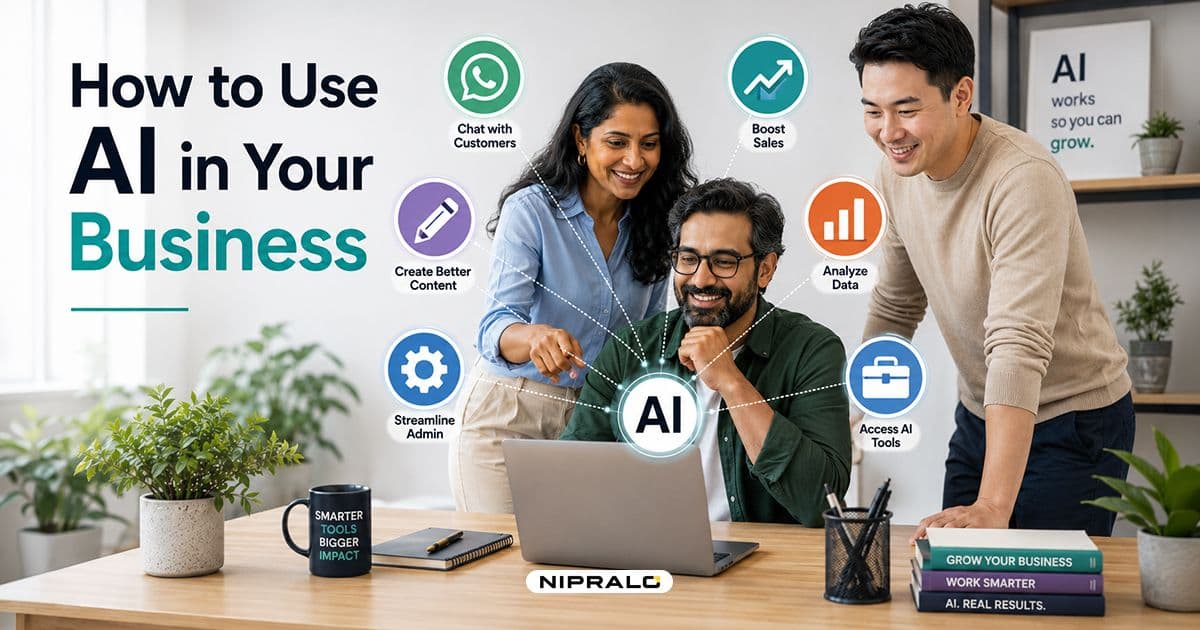
Most business owners think AI means hiring a data scientist or buying software that costs more than a car. It doesn't.
Right now, in 2026, the average small business using AI runs about five different tools. None of them needed a developer to set up. Most cost less than the monthly tea-and-snacks bill for the office.
Here's the part nobody says out loud: India leads the world in SMB AI adoption. Around 59% of small and mid-sized businesses here already use AI in daily operations. So if you're still "thinking about it", the shop down the road probably isn't.
This is a plain guide on how to use AI in your business. No code. No IT team. No jargon. Just six things owners are actually doing right now, with real examples and what each one costs.
First, forget what AI sounds like
AI is not one big scary thing you "install". It's a set of small helpers that each take one annoying job off your plate.
Think of it like hiring. You wouldn't hire one person to do everything. You'd hire someone to handle calls, someone for the books, someone for marketing. AI works the same way. One tool answers customers. Another writes your posts. A third reads your sales numbers.
And the proof is in the results, not the hype. In a February 2026 survey of small businesses, 78.6% of those using AI said it cut their costs or improved efficiency. That's not a promise. That's owners reporting what already happened.
So here are the six jobs owners are handing to AI in 2026.
1. Answering customers on WhatsApp, day and night
This is the biggest one in India, and it's not close.
Around 487 million Indians use WhatsApp. A Kantar study found 91% of online adults here chat with a business every week. Your customers don't want to email you or fill a form. They want to message you. And they want a reply now, not tomorrow morning.
An AI chatbot sits on your WhatsApp Business number and answers the common stuff automatically. Order status. Price lists. Opening hours. Booking a slot. It replies in seconds, in Hindi, English, or a regional language, even at 11pm when you're asleep.
In May 2026, Meta launched Business AI on WhatsApp for small businesses in India, free, no coding, set up inside the WhatsApp Business app. Tools like Wati and AiSensy do the same with more control. Owners using them report saving 15 to 25 hours a week and handing off the work of 2 to 3 support staff to one person plus the bot.
A clothing store in Pune, for example, can let the bot confirm orders and share UPI payment links while the owner actually runs the store.
2. Writing marketing content in minutes, not days
Captions. Product descriptions. Festival offers. Reply emails. The stuff that eats your evening.
A tool like ChatGPT writes a first draft of all of it in under a minute. You tell it what you sell and who you're selling to. It gives you ten captions. You pick one, tweak it, post it. Done.
This is where most owners feel the first real win. According to HubSpot's marketing data, businesses using AI save 5 to 15 hours a week on content work alone. That's most of a working day, back in your pocket.
It won't replace a good marketer who knows your brand. But for a small team with nobody doing marketing full-time, it's the difference between posting twice a week and posting nothing.
3. Killing the boring back-office work
Every business has a pile of tasks that aren't hard, just slow.
Summarising a long email thread. Turning meeting notes into action points. Drafting a quotation. Cleaning up a messy customer list. Writing the same reply to the fortieth person asking the same question.
AI chews through all of it. Paste the text, say what you want, get it back formatted and ready. Owners report saving 4 to 8 hours a week on this kind of admin, which is the quiet time-sink most people never measure.
Our team sees this constantly. When we build AI automation for clients, the back-office tasks are usually where the fastest savings show up, because they're repetitive and rule-based. Perfect for a machine, miserable for a human.
4. Chasing leads and following up on sales
Most sales are lost in the follow-up, not the pitch. Someone enquires, you get busy, you forget, they buy from someone else.
AI fixes the forgetting. A CRM with AI built in (Zoho is popular and affordable in India) can score which leads are worth chasing, send automatic follow-ups, and remind you before a deal goes cold. Paired with a WhatsApp tool, it can nudge a customer who left items in the cart, in their own language.
The data backs this up. Among small businesses, 80% of AI users say it's essential for reaching new customers. The bot never gets tired, never skips a follow-up, and never has a bad day.
5. Making sense of your own numbers
You already have data. Sales reports, expenses, which products move and which sit. The problem is finding the time to actually read it.
You can now paste a spreadsheet into an AI tool and ask plain questions. "Which product made the most profit last quarter?" "Why did March sales drop?" "What should I stock more of for Diwali?" It reads the numbers and answers in normal English.
No formulas. No pivot tables. No analyst on payroll. For an owner making real decisions on gut feel, this turns the gut feel into something you can check.
6. Using the AI already hiding in your tools
Here's the one most owners miss entirely. You might already be paying for AI.
Around 74% of small businesses use AI without realising it, through features baked into software they already have. Gmail finishing your sentences. Your accounting tool (like Zoho or Tally) flagging odd transactions. Your CRM ranking leads. Canva removing a background in one click.
So before you buy anything new, look at what you already pay for. Open the settings. The AI feature is often sitting there, switched off, waiting. This is the cheapest win on the whole list, because it costs nothing extra.
So what does this actually cost?
Less than you think. This is the real reason adoption jumped.
A few years ago, this kind of capability needed an engineering team and a big budget. Now most of it runs on a subscription. The single biggest barrier owners report today isn't access anymore. It's cost worry and not knowing where to start, with 61% naming cost as their top concern, often before they've checked the actual prices.
So here are the actual prices. ChatGPT now has local rupee pricing in India, which makes the math simple.
For most owners starting out, the ₹399 Go plan plus a free WhatsApp Business AI setup covers the first three jobs on this list. That's under ₹500 a month to start saving real hours.
Where do you actually start?
Don't try to "do AI". That's where people freeze and give up. Do one thing.
- Pick the single task that wastes the most of your week. Be honest about which one it is.
- Try one tool that targets it. Start with a free or sub-₹2,000 plan. Don't buy big.
- Use it for two weeks and track the hours you save. Real numbers, not a feeling.
- If it works, keep it and automate that win fully. If it doesn't, drop it and try another.
- Only then add a second tool for the next task.
That's it. One task, one tool, two weeks. The owners pulling ahead in 2026 didn't start with a grand plan. They started with one annoying job and built from there.
What about mistakes to avoid?
Three big ones. First, don't paste sensitive customer data (full ID numbers, bank details) into public AI chat tools. Use business plans with proper privacy settings for anything private. Second, don't trust AI blindly. It can sound confident and be wrong, so check facts and numbers before you act on them. Third, don't buy ten tools at once. The median AI-using business runs five tools, and they got there one at a time, not in a week.
Do you need a developer for any of this?
For the six uses above, no. They're built for non-technical owners on purpose. You only need help when you want AI wired deep into your own systems, like connecting a chatbot to your inventory, your billing, and your CRM so they all talk to each other automatically.
That's the point where a custom build pays off, and where our team comes in. You can see the kind of systems and apps we build for that, or read more practical guides on our blog.
The honest bottom line
Knowing how to use AI in your business in 2026 isn't about being technical. It's about picking one painful task and handing it to a tool that costs less than a working lunch.
The businesses winning with AI aren't smarter. They just started. They tried one thing, saw the hours come back, and built from there while everyone else kept "exploring".
Pick your one task this week. That's the whole secret.
Not sure which task to hand to AI first?
Book a free 20-minute call. We'll look at your business, find the one job AI should take over first, and tell you honestly whether you need a tool or a custom build.
Frequently Asked Questions
How can a non-technical business owner start using AI?

Start with one task that wastes the most time each week, not with AI as a whole. Pick one tool that targets it, try a free or low-cost plan for two weeks, and track the hours you save. If it works, keep it and add a second tool later. You do not need to code or hire anyone to begin.
What does AI actually cost for a small business in 2026?
Far less than most owners expect. A basic ChatGPT plan in India starts at 399 rupees a month, and WhatsApp Business AI can be set up free inside the WhatsApp Business app. Many businesses run their first useful setup for under 500 rupees a month before scaling up.
Which AI tools are best for small businesses in India?
It depends on the job. For customer chat, WhatsApp tools like Wati and AiSensy are popular. For content and writing, ChatGPT and Canva work well. For sales and leads, Zoho CRM is affordable and widely used. Many businesses also already have AI built into Tally, Zoho, or Gmail.
Can AI replace employees in a small business?
Usually it replaces tasks, not people. AI handles repetitive work like answering common questions, drafting content, and sending follow-ups, which frees your team for work that needs a human. Some businesses reduce support staff, but most use AI to do more with the team they already have.
Is it safe to put my business data into AI tools?
It is safe for general work, but avoid pasting sensitive details like full ID or bank numbers into public chat tools. Use business or team plans that offer proper privacy controls for anything private. Always check the tool's data policy before sharing customer information.