
All Posts
Is SEO Still Worth It in 2026? An Honest Answer After AI Changed Search
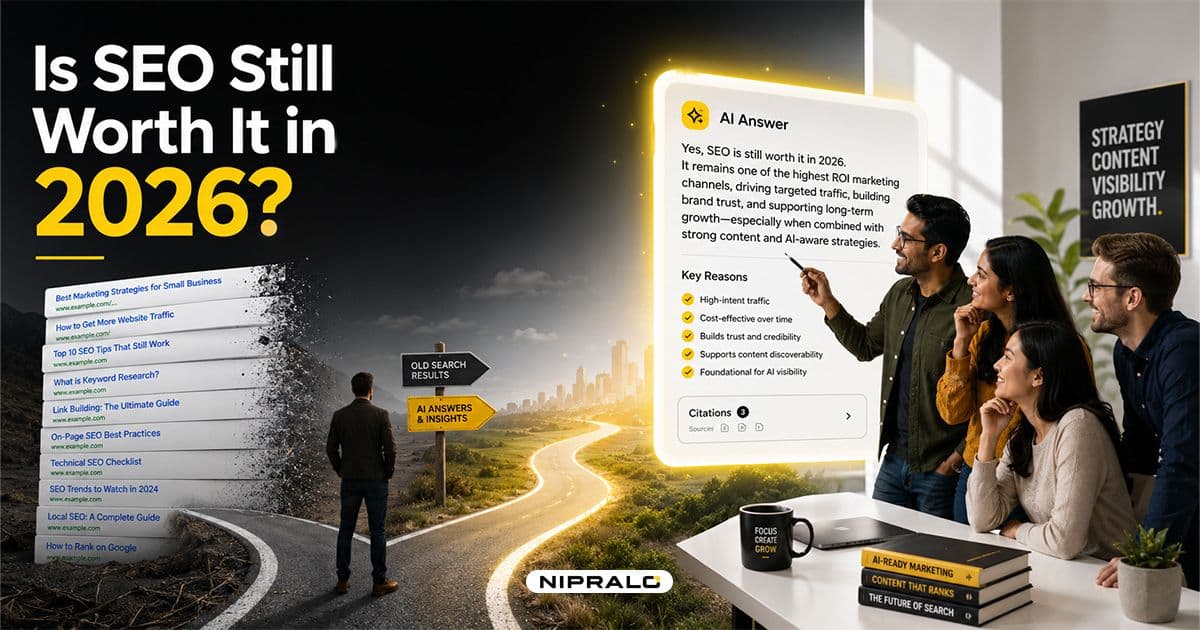
Last year, ranking number one on Google meant traffic. Now it can mean almost nothing.
Here is the number that worries business owners. AI Overviews now appear on roughly 48% of all Google searches, up from 34.5% in December 2025 (Ahrefs data, via The Slide Factory). That is a 58% jump in three months. And when Google's AI Mode answers a query, 93% of those searches end with zero clicks to any website.
So the question is fair. Is SEO still worth it in 2026, or are you funding a channel that quietly died?
Short answer: SEO is not dead. The old version of it is. The scoreboard changed, and most businesses are still playing the 2023 game, then wondering why the score stopped moving.
Let us walk through what changed, what still works, and what you should stop paying for. No hype.
What actually changed
Google used to send you to a list of links. You picked one, clicked, landed on a site. That was the deal for twenty years.
Now Google reads the top sources, writes its own answer, and puts it above everything. The links still exist. Most people just stop reading before they reach them.
The damage is not even across the board. When an AI Overview sits above the results, the number one organic result loses about 18% of its clicks. Informational searches, the how-to and what-is type, have lost 30 to 40% of clicks on affected queries.
But here is the part the panic headlines skip. Sites cited inside an AI Overview earn about 35% more clicks than a normal number one ranking. Being in the answer beats ranking below it. That one shift rewrites the whole goal of SEO.
So is SEO still worth it in 2026?
Yes. But not the way you were sold it.
Think of it as three jobs now, not one. The first is classic SEO: getting found and crawled. The second is AEO, answer engine optimisation: getting quoted inside answer boxes. The third is GEO, generative engine optimisation: getting cited by AI tools like ChatGPT, Gemini, and Perplexity when someone asks them a question.
Is SEO dead in 2026?
No. SEO is the foundation everything else sits on. AI engines pull most of their answers from pages that already rank well, so a strong SEO base makes you more likely to be cited, not less. What died is thin, keyword-stuffed content built only to catch a search. AI can summarise that in one line and make your page pointless.
What actually died
Rand Fishkin published an analysis in April 2026 of 400 sites that survived the traffic drop of the last two years. The pattern was clear. The sites that collapsed were producing generic, interchangeable content, the kind AI can replace entirely. The ones that held up had something only they could say.
So the threat was never AI. The threat is content anyone could have written. AI just made that weakness impossible to hide.
What to stop doing in 2026
Some habits are now actively wasting your money. Cut them.
Stop chasing keyword volume as the main goal. Stop publishing thin pages that exist only to rank. Stop buying cheap backlinks. And stop judging success by rank position alone, because a number one spot under an AI answer can bring fewer visitors than a single cited mention inside it.
What works now
The new playbook is simpler than it sounds. And it favours small businesses more than you would expect.
Structure wins. Content with clear schema markup, real statistics, and a proper FAQ structure shows 30 to 40% higher visibility in AI answers. Headings written as real questions get matched to real queries. A header that reads "What is GEO?" gets cited more than one that reads "GEO Overview."
Proof wins. Original data, case studies, named results, specifics only your business has. AI cannot invent your client outcomes. It can only cite them if you publish them.
Does this help small businesses or hurt them?
It helps. AI judges how well you answer, not how big your ad budget is. A focused service page that clearly explains what you do, who you help, and what you deliver can outperform a vague page from a far bigger competitor. Nearly 47% of brands still have no GEO strategy at all (HubSpot's 2026 GEO guide), which means the door is wide open right now.
What about India specifically?
The shift is real but uneven here. In India, Perplexity grew 640% year on year and ChatGPT is now the second most used platform among Indian professionals. At the same time, Google still sends roughly 345 times more traffic than ChatGPT, Gemini, and Perplexity combined as of late 2025. So the smart move for an Indian business is not to abandon Google. It is to optimise for both at once, while competitors hesitate.
Our team at Nipralo has watched this play out with clients across Mumbai and beyond. The businesses winning leads in 2026 are not the ones with the most pages. They are the ones whose pages actually answer the question a customer is asking.
Where to start if you only do three things
You do not need a full overhaul to begin. You need three moves.
- Audit your top pages and rewrite the headings as the exact questions your customers ask. Then answer each one clearly in the first two or three sentences.
- Add schema markup and a real FAQ section to your service pages so both Google and AI engines can read your content cleanly. The Google Search Central documentation covers the basics for free.
- Publish one piece of proof a month. A case study, a real number, a result only you can claim. This is what gets you cited, not summarised.
That is the core of it. If you want help finding what is bleeding traffic and what to fix first, that is exactly the kind of work our digital marketing and SEO team handles, alongside the websites and apps we build to make all of it rank and convert.
SEO in 2026 is not about gaming an algorithm. It is about being the clearest, most trustworthy answer to a real question. Do that, and you get found by Google, quoted by AI, and chosen by customers.
The businesses that adapt now get a head start while half their market is still frozen. The ones that wait will pay more to catch up later.
Not sure if your SEO is still working?
Book a free 20-minute call. We will look at what AI search is costing you and show you the two or three fixes that move the needle first.
Frequently Asked Questions
Is SEO dead in 2026 because of AI search?

No. SEO is not dead, but the old keyword-first version of it no longer works on its own. AI engines pull most of their answers from pages that already rank well, so strong SEO is now the foundation for getting cited by AI. What stopped working is thin, generic content that AI can summarise and replace.
How do Google AI Overviews affect website traffic?
AI Overviews appear on close to half of all Google searches in 2026 and answer the query before the user clicks. The number one organic result loses roughly 18 percent of its clicks when an AI Overview sits above it, and informational queries can lose 30 to 40 percent. Sites cited inside the AI Overview, however, earn about 35 percent more clicks than a standard top ranking.
What is the difference between SEO, AEO, and GEO?
SEO is about ranking in Google's standard search results through keywords, links, and site quality. AEO, or answer engine optimisation, is about getting quoted inside featured snippets and AI Overviews. GEO, or generative engine optimisation, is about getting cited by AI tools like ChatGPT, Gemini, and Perplexity. In 2026 a business needs all three working together rather than just one.
Should small businesses still invest in SEO in 2026?
Yes, and the shift actually favours them. AI search rewards clear, trustworthy answers over big advertising budgets, so a focused page can outperform a vague one from a larger competitor. Nearly half of all brands still have no AI search strategy, which leaves an open window for early movers. The key is to optimise for both Google and AI tools at the same time.
How long does SEO take to show results in 2026?
Most businesses start seeing movement within eight to twelve weeks, though competitive terms take longer. AI engines favour fresh, well structured content, so regular updates and clear answers speed things up. Local and branded searches usually show results faster than broad national keywords.