
All Posts
AI Strategy 2026: Every Reason Companies Have One, Real ROI, and Hype Ranked
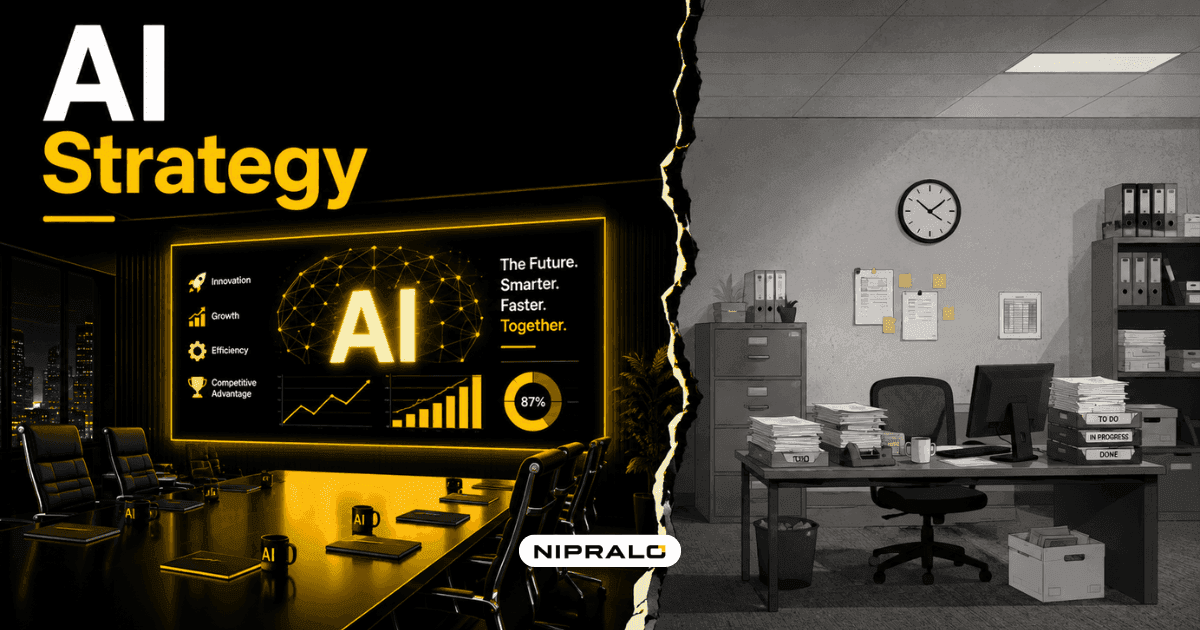
Sometime in the last two years, your competitors all announced an "AI strategy." So did their competitors. So did companies that sell garden furniture.
And here is the awkward part nobody says out loud at the conference: most of them cannot tell you what it actually changed. There is a slide. There is a press line. There may even be a Head of AI. But ask which real task got faster, cheaper, or better, and the room goes quiet.
That gap, between announcing an AI strategy and getting anything from one, is the whole story. This post is about why every company suddenly has one, how much of it is theatre, and what an AI strategy that touches actual work looks like. We build AI automation for a living, so we have watched this from the inside. This is the honest version.
Why the sudden rush
Nobody woke up one morning wiser about AI. Three pressures hit at once, and they had nothing to do with whether AI actually helped the business.
Investors started asking
The moment AI became the story, every investor and board member began asking the same question in every meeting: "So, what's our AI strategy?" A CEO with no answer looks asleep at the wheel. So an answer appeared, whether or not the substance behind it did.
Everyone else announced one
Once a few big names announced AI initiatives, staying quiet started to look like falling behind. Announcements became defensive. You announce because they announced, not because you found a problem AI solves. It is a herd moving, not a plan forming.
Real fear of being left behind
And underneath the theatre sits a real, reasonable fear. AI genuinely is changing how work gets done. No leader wants to be the one who ignored it and got overtaken. That fear is legitimate. It just does not, by itself, produce a good strategy. It mostly produces a fast one.
How much of it is theatre
Here is the number that should reset expectations. The widely-reported pattern, often traced to MIT and McKinsey, is that a large majority of enterprise AI pilots deliver little or no measurable return. A small minority capture most of the value.
Read that again. Most AI initiatives are not quietly succeeding. They are quietly going nowhere. The strategy exists on a slide. It never reached a single real workflow. That is not an argument against AI. It is an argument against AI-by-press-release.
So what separates the minority that works from the majority that does not? It is rarely the model or the budget. It is whether the strategy was aimed at a real, specific problem or aimed at the board.
What a real AI strategy actually looks like
Forget the word "strategy" for a second, it is doing too much work. A real AI strategy is just this: you found a specific task that eats time or money, and you used AI to make it measurably better. That is it. Everything else is decoration.
The companies in the winning minority tend to do the same unglamorous things.
- They start with a problem, not a tool. Not "how do we use AI" but "what wastes our time, and could AI help." The order matters enormously.
- They pick one workflow. Support ticket triage. Invoice processing. Drafting first-pass content. One real thing, done properly, beats a company-wide vision that touches nothing.
- They measure a real number. Hours saved. Errors cut. Response time dropped. If nothing measurable moved, the strategy is still theatre, no matter how good the slide looked.
- They keep a human in the loop. The wins pair AI with a person who catches what it gets wrong, rather than trusting it blindly and getting burned.
A real example
A services business we worked with did not want an "AI strategy." They wanted to stop drowning in the same customer questions every day. So we built one thing: an AI layer that drafted answers to routine queries, with their team approving each before it sent. One workflow. A number that moved. No press release. That is what a real strategy looks like, and it is the heart of our AI automation work.
How a normal business should approach it
If you run a small or mid-size business and feel the pressure to "have an AI strategy," here is the honest shortcut. Skip the strategy. Find the annoyance.
- Name your most repetitive task. The thing your team does over and over that drains hours. That is your candidate, not whatever is trending.
- Ask if AI genuinely helps there. Sometimes yes, sometimes a simple automation or a fixed process is the better answer. Be honest.
- Pilot it small. One workflow, one team, one month. Measure before and after.
- Keep it or kill it on the number. If it moved a real metric, expand. If it did not, drop it without ceremony and try the next task.
Do that three times and you have something most companies with a glossy "AI strategy" do not: proof. For a grounded read on where enterprise AI actually stands, Gartner's AI research is a useful reference, and you can see the kind of automation our team builds on our web and app work.
The short version
Every company suddenly has an AI strategy because investors asked, competitors announced, and nobody wants to be left behind. Fair pressures, but they produce fast strategies, not good ones. And a large majority of AI pilots return little or nothing, because the strategy lived on a slide and never touched real work. A real AI strategy is unglamorous: one specific problem, one workflow, one number that moved, a human in the loop. Skip the theatre. Find the annoyance. Fix that. The proof beats the press release every time.
Want an AI strategy that touches real work?
Book a free 20-minute call. Tell us your most repetitive, time-draining task and we will tell you straight whether AI actually helps there, and what a small pilot would look like.
Frequently Asked Questions
Why does every company suddenly have an AI strategy?

Three pressures hit at once: investors and boards started asking every CEO the AI question, competitors announced their own initiatives, and there is a real fear of being left behind. Those pressures produce fast announcements, not necessarily good strategies, which is why so many exist only on a slide.
What is an AI strategy for a business?
Stripped of jargon, an AI strategy is simply a plan to use AI to make a specific task measurably faster, cheaper, or better. A real one starts with a painful problem rather than a tool, targets one workflow, and is judged by whether an actual number moved.
Do most company AI initiatives actually work?
Most do not show measurable returns. Reporting often traced to MIT and McKinsey suggests a large majority of enterprise AI pilots deliver little or no measurable value, while a small minority capture most of it. The difference is usually whether the effort targeted a real workflow or just the boardroom. Entry 4 question (max 200 chars): What does a real AI strategy look like? answer: It is unglamorous. A real AI strategy starts with a specific painful problem, targets one concrete workflow such as ticket triage or invoice processing, measures a real number like hours saved, and keeps a human in the loop to catch mistakes. No press release required. Entry 5 question (max 200 chars): How do small businesses build an AI strategy? answer: Skip the grand strategy and find the annoyance. Name your most repetitive, time-draining task, ask honestly whether AI genuinely helps there, pilot it small for about a month, and keep or kill it based on whether a real metric moved. Repeat with the next task. schema_jsonld json { "@context": "https://schema.org", "@type": "HowTo", "name": "How a normal business should build an AI strategy", "description": "A practical four-step approach for a small or mid-size business to build an AI strategy that touches real work.", "step": [ { "@type": "HowToStep", "name": "Name your most repetitive task", "text": "Identify the task your team repeats constantly that drains hours, rather than chasing whatever AI trend is popular." }, { "@type": "HowToStep", "name": "Ask if AI genuinely helps", "text": "Be honest about whether AI is the right fit, since sometimes a simple automation or a fixed process works better." }, { "@type": "HowToStep", "name": "Pilot it small", "text": "Run it on one workflow with one team for about a month, measuring the metric before and after." }, { "@type": "HowToStep", "name": "Keep it or kill it on the number", "text": "Expand if a real metric moved, and drop it without ceremony if it did not, then try the next task." } ] } Before publishing: fill in datePublished with today's date, add your cover image URL to the image field if present, and validate at search.google.com/test/rich-results image_generation_prompt Modern flat illustration, 16:9 horizontal cover 1200x630, a clean split composition contrasting two sides: on the left a polished boardroom presentation screen glowing with the letters "AI" and a big applause-worthy slide, on the right the same building's quiet back office where an ordinary everyday workflow of stacked papers and a plain desk sits completely untouched, a subtle gap or crack down the middle to signal the distance between the announcement and the reality. No real identifiable people in image, use simple abstract figures only if any appear. Sharp, slightly wry and editorial mood with bright even lighting. Color palette of dark ink black #0c0c0d, warm yellow accent #fcca31, and clean white with one soft grey for the untouched side. The words "AI Strategy" rendered top-left in clean modern sans-serif, professionally typeset, sharp and correctly spelled, magazine-cover typography quality, no gibberish, no warped letters, no dummy text. High detail, generous negative space, balanced composition. Avoid: distorted hands, extra fingers, melted or garbled text, misspelled words, generic stock-photo clichés, cluttered background, watermarks, signatures, low quality, blurry. Paste this into your preferred image AI. Best tool matches: Ideogram (strongest for in-image text accuracy), Midjourney v6 (best stylized look), Flux.1 (most realistic), GPT Image (balanced all-rounder).
What does a real AI strategy look like?
It is unglamorous. A real AI strategy starts with a specific painful problem, targets one concrete workflow such as ticket triage or invoice processing, measures a real number like hours saved, and keeps a human in the loop to catch mistakes. No press release required.
How do small businesses build an AI strategy?
Skip the grand strategy and find the annoyance. Name your most repetitive, time-draining task, ask honestly whether AI genuinely helps there, pilot it small for about a month, and keep or kill it based on whether a real metric moved. Repeat with the next task