
All Posts
Why Your Google Traffic Dropped in 2026: Where It Actually Went
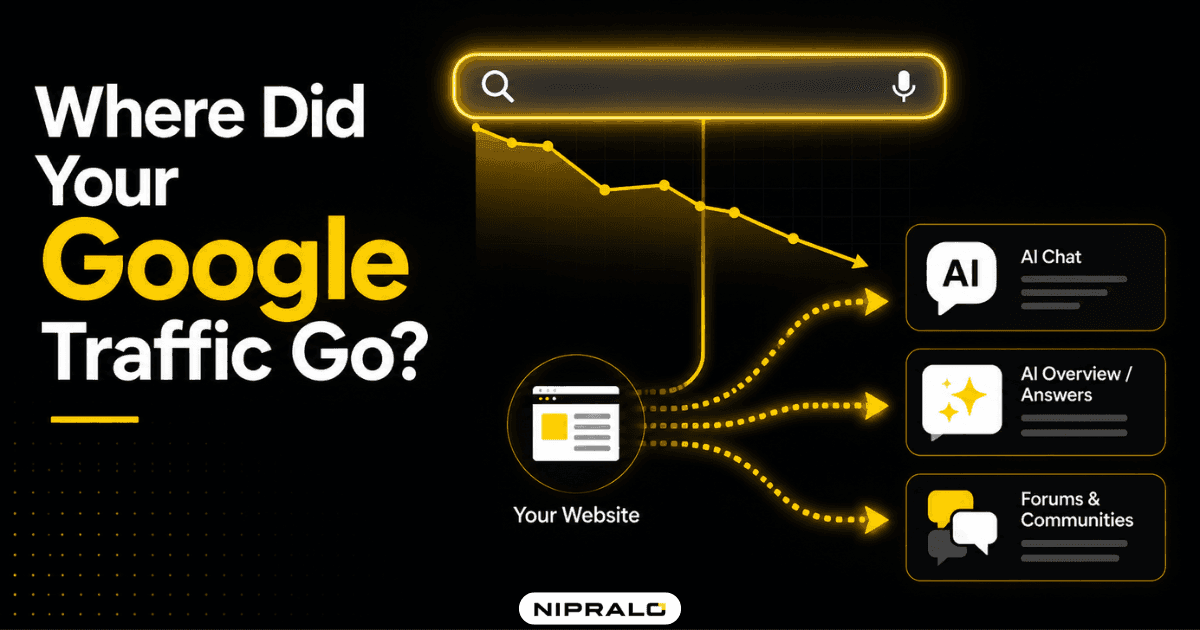
Your traffic did not vanish. It got intercepted.
You open Search Console and the line is doing the thing you hoped it would not. Impressions steady, maybe even up. But clicks sliding down a slope that started last year and never flattened out.
Here is the part worth knowing before you rewrite a single meta description. Your traffic probably did not disappear. It got intercepted. And knowing where it went changes what you do next.
For most sites, the 2026 drop is not a ranking problem. You can hold position two for a keyword and still lose half your clicks. Because the click now happens somewhere above your result, or it never happens at all.
That is the shift. Google stopped being a directory that hands you off. It became a destination that answers the question itself. The traffic you lost mostly went to four places.
Where your Google traffic actually went
Into the AI answer at the top of the page
The single biggest interceptor. When Google generates an answer inline, the question gets resolved before the reader scrolls. Your result still ranks. It may even be cited as a source. But the click-through collapses because the reason to click is gone. Informational "how do I" and "what is" queries got hit hardest. Transactional and navigational queries held up better.
Into zero-click results generally
This one predates AI answers and kept growing. Featured snippets, "people also ask", knowledge panels, rich results. They satisfy the intent on the results page itself. A large share of searches now end with no click to any website. Not because people gave up. Because they got what they came for.
To the chatbot instead of the search bar
This is the genuinely new leak. A real slice of the queries that used to start on Google now start in ChatGPT, Gemini, Perplexity, or Claude. Someone asks the assistant "best framework for X" or "how do I fix Y". There is no results page, no ranking, often no link. Just an answer. You can sometimes spot the residue as referral traffic from those domains. Most of it is invisible: the visit that never happened.
To forums and user-generated content
Google leaned hard into "real people" results. Reddit, Quora, community threads, YouTube. For opinion-shaped queries like "is X worth it" or "best Y for Z", those now outrank most business pages. So even the clicks that still happen increasingly land on someone else's thread, not on your page.
Layer a core update or two on top of all this, the ongoing reshaping around genuinely helpful, first-hand content, and a site can take a compounding hit. It feels like a penalty. It is really the sum of these forces.
How to tell which one is hitting you
Before you react, diagnose. The fix for "AI answers ate my click-through" is not the fix for "a core update demoted me".
Pull your top 20 queries in Search Console. Split them by intent: informational, commercial, transactional. Watch which bucket bled. That one report tells you most of the story.
What to do about it, if you actually build things
The reflex is to write more blog posts. In 2026 that is often the worst move. More thin informational content is exactly what is getting intercepted. Here is the more durable playbook.
Optimise to be cited, not just ranked
Answer engines pull from clear, well-structured, genuinely authoritative pages. Answer-first formatting, clean semantic HTML, real structured data. Being the source an AI quotes is the new page one. Google's own Search Central docs still spell out the fundamentals that make a page eligible.
Shift content toward queries that still convert
Bottom-funnel, high-intent pages resist interception. Comparisons, pricing, implementation detail, real case studies. The searcher wants to act, not just learn. That is where the remaining clicks carry real value.
Get the technical foundation right
When ranking signals compress, speed, mobile performance, crawlability, and correct schema stop being nice-to-haves. They decide who gets surfaced and cited. A fast, clean build is table stakes now. It is the part our team spends most of its time on, and you can see the kind of work we mean in our web and app portfolio.
Stop renting your whole audience from Google
The real lesson of 2026 is dependency risk. Build channels you own. Email, a real community, a product people return to directly, demand people search for by name. Traffic you do not control can be reallocated overnight. Traffic you own cannot.
Treat your website as a conversion asset
If fewer visitors arrive, each one has to work harder. Clear positioning, fast load, a frictionless path to contact or buy. The site's job shifts from capturing volume to converting intent. If that is the rebuild you are facing, our team does exactly this.
The takeaway
Your Google traffic dropped in 2026 because the front door of the internet changed shape. Search got better at answering. Assistants absorbed a chunk of the demand. The results page kept more people on it.
None of that reverses by chasing keywords the old way. The teams that come out ahead stop optimising for a results page that is shrinking. They build to be the cited source, they own their audience, and they make every visitor count.
Watching your traffic slide and not sure why?
Book a free 20-minute call. Our team will look at your Search Console data with you and show you which of these is actually hitting your site.
Frequently Asked Questions
Why did my Google traffic drop in 2026 even though my rankings stayed the same?

Because the click now often happens above your result or not at all. AI answers and zero-click features resolve the query on the results page, so a stable ranking can still lose most of its clicks. It is a presentation shift, not a ranking drop.
Where did the lost Google search traffic actually go?
Mostly to four places. AI answers at the top of search, zero-click features like snippets and panels, answer engines such as ChatGPT and Perplexity, and forums like Reddit that Google now favours. Each one intercepts a different type of query.
Are AI Overviews the main reason organic traffic fell?
For informational queries, usually yes. When Google answers inline, the reason to click disappears even if your page is cited as a source. Transactional and navigational queries were affected far less.
How do I find out which factor is hurting my site?
Pull your top queries in Search Console and split them by intent. Flat impressions with falling clicks points to interception. Falling impressions and position points to an algorithm re-rating. Rising referrals from AI domains points to a channel shift.
Can I recover the traffic I lost to AI and answer engines?
Some of it, but not by repeating old tactics. Structure pages to be cited by AI, focus on high-intent content that still earns clicks, fix technical foundations, and build channels you own so you depend less on search. The goal is resilience, not just recovery.